

It’s difficult to have a conversation with a PR leader these days without someone wondering what ChatGPT says about their organization. The question often gets asked right after the CEO has checked ChatGPT themselves (and didn’t love what they saw).
Answering that question well takes more than typing a few prompts and saving screenshots.
That’s why CARMA provides two integrated products.
AI Visibility, available inside the CARMA Insight platform, tracks how your organization appears in AI answers in the markets that matter to you.
LLM Perception is an analyst-led engagement in which CARMA’s experts dig into what those results mean for your reputation and what to do about them. Together, they deliver ongoing insights, expert analysis, and practical recommendations on how AI represents you around the world.
A global view, market by market
AI answers aren’t the same everywhere. The same question can return different brands, different sources, and a different story depending on where it’s asked.
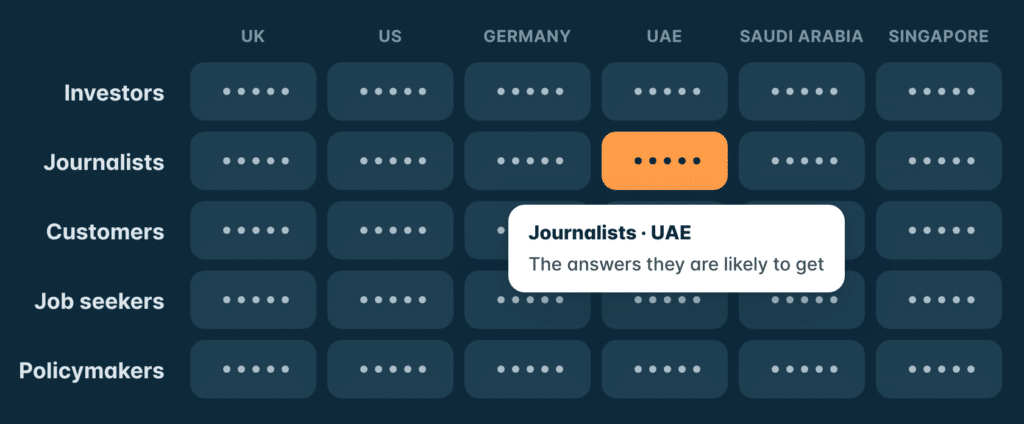
With both AI Visibility and LLM Perception, you can regionalize prompts to see how you appear in each market where you operate.
That’s what you’d expect from CARMA as a global media intelligence company, and it gives you a view of AI answers that matches your organization’s footprint.
CARMA analysts help you understand what the results mean
Tracking tells you where you stand, but deciding what to do about it is usually where teams want help.
CARMA’s analysts work with you to scope the personas, markets, audiences, and question types that matter most, run a defined set of prompts across AI models, and analyze visibility, sentiment, citations, and narratives. The findings are benchmarked against your earned and owned media and against named peers.
You get written, insight-led analysis, a clear view of where you’re strong and where gaps exist, and practical recommendations for improving how AI represents you.
Measurement built on industry standards
With all the hype and attention that AI receives, it’s easy for the numbers to get ahead of what they can actually tell you. That tends to give rise to vanity metrics designed to make you feel good.
Both AI Visibility and LLM Perception are consistent with AMEC’s GEO Principles, so you get insights you can trust.
Your coverage and the sources AI cites, integrated in CARMA Insight
AI assistants don’t form opinions of their own. They draw on what’s already been written, and much of what they cite is earned and owned content.
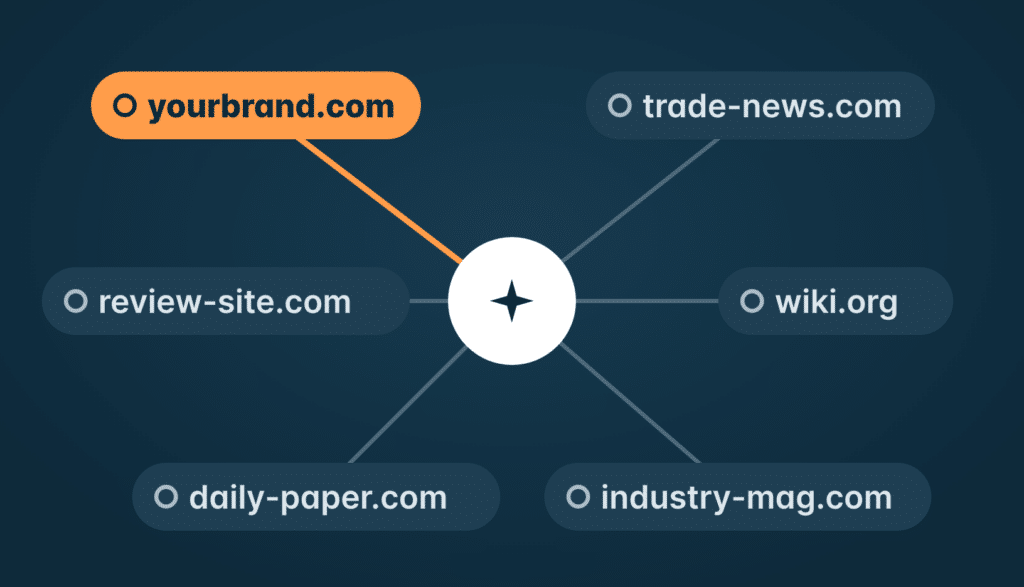
AI Visibility shows which domains AI assistants cite when they talk about you, how often, and each domain’s share of all citations. That tells you which editorial outlets, organizations, and other sites are carrying your story, and how much of it comes from your own online properties.
As LLMs emerge as another important channel alongside traditional media and social coverage, it makes sense to be able to monitor and analyze your results in the same platform. That’s why AI Visibility sites inside CARMA Insight, enabling you to see the bigger picture and make smarter decisions.
What you’ll see in the AI Visibility dashboard
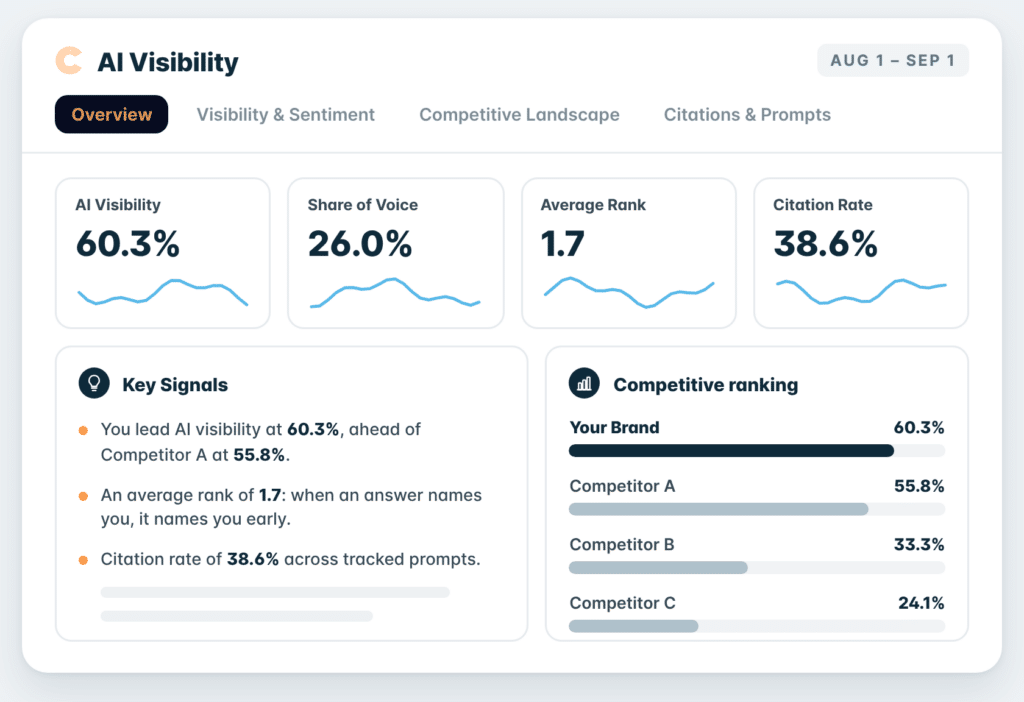
AI Visibility covers six AI assistants (ChatGPT, Claude, Gemini, Perplexity, Grok, and Mistral). It tracks prompts rather than keywords, so you see where you show up, how prominently, how you’re described, and where you may be missing.
Among the highlights:
- Headline metrics: visibility, share of voice, average rank, and citation percentage, plus an engine-by-engine view.
- Competitive benchmarks: who appears alongside you, and who appears instead of you, among the competitors you care about.
- Decision stages: prompts grouped by where people are in their thinking (comparing options, building a shortlist, weighing a purchase, judging trust and reputation, or looking into risks and issues), so you can see where you stand within each.
- The responses themselves: the actual answers behind each result, with sentiment marked as positive, neutral, or negative.
- Key Signals: AI-generated summaries that lead with the most important finding in plain language and point you to where to dig deeper.
- Trends: each measure compared with the previous period.
That gives you a clear, up-to-date picture to walk leadership through, rather than a pile of random screenshots from someone’s ChatGPT session.
Getting started with AI Visibility and LLM Perception
If you’d like to see how your organization shows up with AI Visibility, or learn more about an LLM Perception engagement, get in touch with your CARMA account team or request a free consultation.