

Budget day is one of the most intense days in the communications calendar. The headlines are written in hours, but the reputational consequences can last for years. So rather than another Budget summary, I want to look at one announcement through a comms lens and walk through how I would respond.
What happened
On 28th October, John Healey doubled the bank surcharge from 3% to 6% for 15 months, to help pay for energy support. Savers took a hit too, with tax on savings interest rising to 24%, 44% and 49% from April 2027.
Then, on 5th November, the Bank of England raised rates to 4%, its first rise in more than three years. The BBC summed it up neatly: for borrowers, the rise « will push up the cost of borrowing »; for savers, it « could offer a boost ». That « could » is where the reputational risk now sits.
What’s at stake
Imagine you lead comms at a UK high-street bank. Customers are worried about bills and savings. Policymakers have just handed you the bill. Investors are watching your margins. Your job is to avoid being cast as either the villain or the complainer, and to come out of the next 15 months with trust intact. And since this week, you’re on the clock: customers will be watching whether savings rates move as fast as mortgage rates.
What I’d do
1. Read the coverage, not just the headlines. The Chancellor’s phrase « breathing space » appeared in 72 of the 250 Budget articles CARMA analysed. It travelled, but it didn’t persuade: 30 of those articles used it against him. Repetition buys reach, not belief. Speculation matters too. Pre-Budget talk of an 8% surcharge meant 6% landed as « smaller than feared ».
For the banks, the bigger story was timing. Lloyds made up about a third of the bank coverage, after its finance chief called the tax « unhelpful » on the same day it reported near-doubled profits. Every complaint about the tax landed next to a headline about profits. With rates rising again, that contrast will only get sharper. (PR measurement & research)
2. Listen to the public, not just the press. Online, CARMA’s social listening picked up 5,000 UK posts. The conversation peaked on Budget day and was largely over within three days. Negative posts outnumbered positive ones almost two to one, and most of the positivity was about savers keeping their £20,000 ISA allowance, not about banks. Banks were attacked from both sides at once: a windfall tax petition said the surcharge didn’t go far enough given « obscene bank profits », while former Chancellor Kwasi Kwarteng said it would simply be « passed on to customers ». Outside the industry, almost nobody was making the case for the banks. (Media monitoring & social listening)
3. Check what AI is telling your customers. More and more people ask an AI assistant before they read a press release. So on 5th November, we put 19 Budget questions to six AI assistants. On savings products, banks’ own websites were cited regularly. On the questions that shape reputation, such as whether banks will pass the cost on or make too much profit, they made up under 1% of 680 sources. The Trades Union Congress alone was cited more than twice as often as every bank combined. Five of the six assistants told customers the cost would probably be passed on to them, and one even said the cash ISA allowance was still being cut. If you don’t tell your story where AI is looking, someone else will. (Custom AI & reporting)
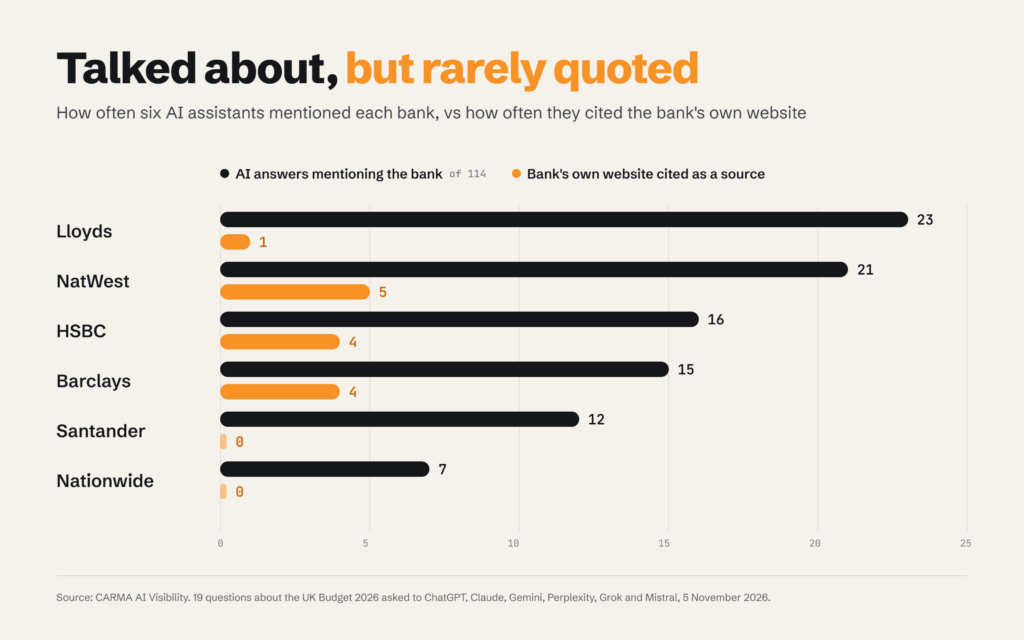
4. Choose contributor over complainer. Nobody is telling the story of banks as willing contributors: « fair share » appeared in two of 250 articles and none of 114 AI answers. That space is open. The most credible proof point this week is simple: pass the rate rise on to savers, quickly and visibly. Leave the policy argument to the trade body, and spend your own voice helping customers with the savings tax changes, the £20,000 ISA allowance and the £100 energy payment. Helpful beats aggrieved, every time. (Strategic counsel)
What good looks like
In three months, success would be measurable:
- Coverage shifting from « profits » and « tax raid » to « passing it on » and « helping customers ».
- Trust holding steady through the winter, when household budgets are tightest.
- Your own explainer among the sources AI assistants cite on savings questions.
The Budget lasted one afternoon. The story it started will run for 15 months. The banks that come out of it well won’t be the ones who shouted loudest on Budget day. They’ll be the ones who listened first.
If you’re working through the Budget fallout with your own leadership team, I’d be glad to compare notes.
