Sector Spotlight: Accommodation

1st May - 16th June 2026

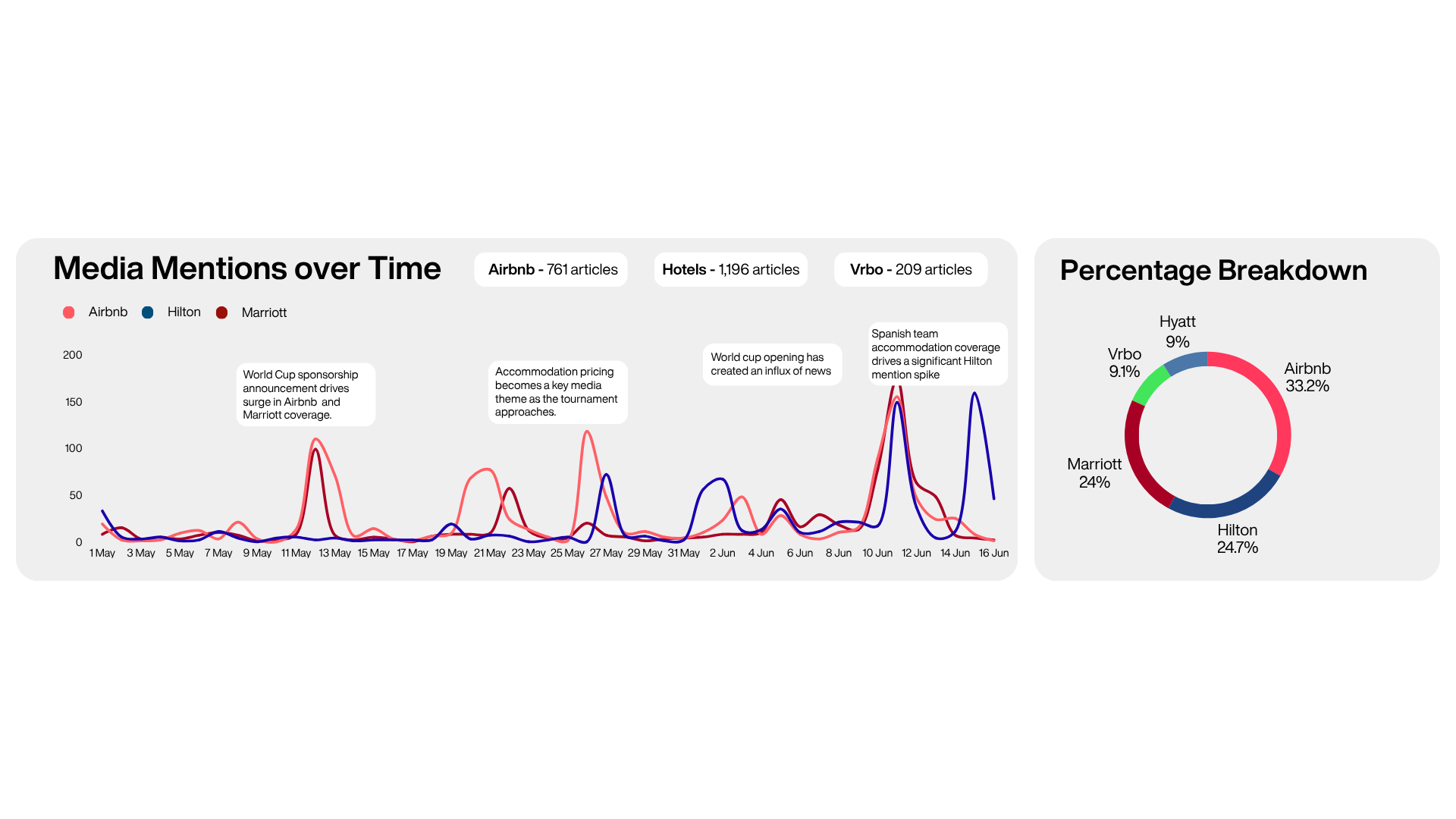
In this issue, we analysed 3,141 articles, tracked four leading accommodation brands (Airbnb, Hilton, Marriott International, and Hyatt), and identified 10 key themes.

Market Snapshot

The accommodation conversation is led by Airbnb, while individual hotel brands appear more contextually.

The FIFA World Cup created a significant moment for the accommodation sector, generating media attention across sponsorships, team travel, host-city demand, and fan experiences. As brands sought to position themselves within the tournament ecosystem, varying levels of visibility and engagement emerged.

This report explores how leading accommodation brands featured within the World Cup conversation, highlighting the moments, themes, and narratives that drove attention throughout the tournament period. Drawing on both news and social media analysis, it provides a view of the sector-wide trends shaping discussion, alongside the unique factors influencing visibility for individual brands.
Social Media Overview

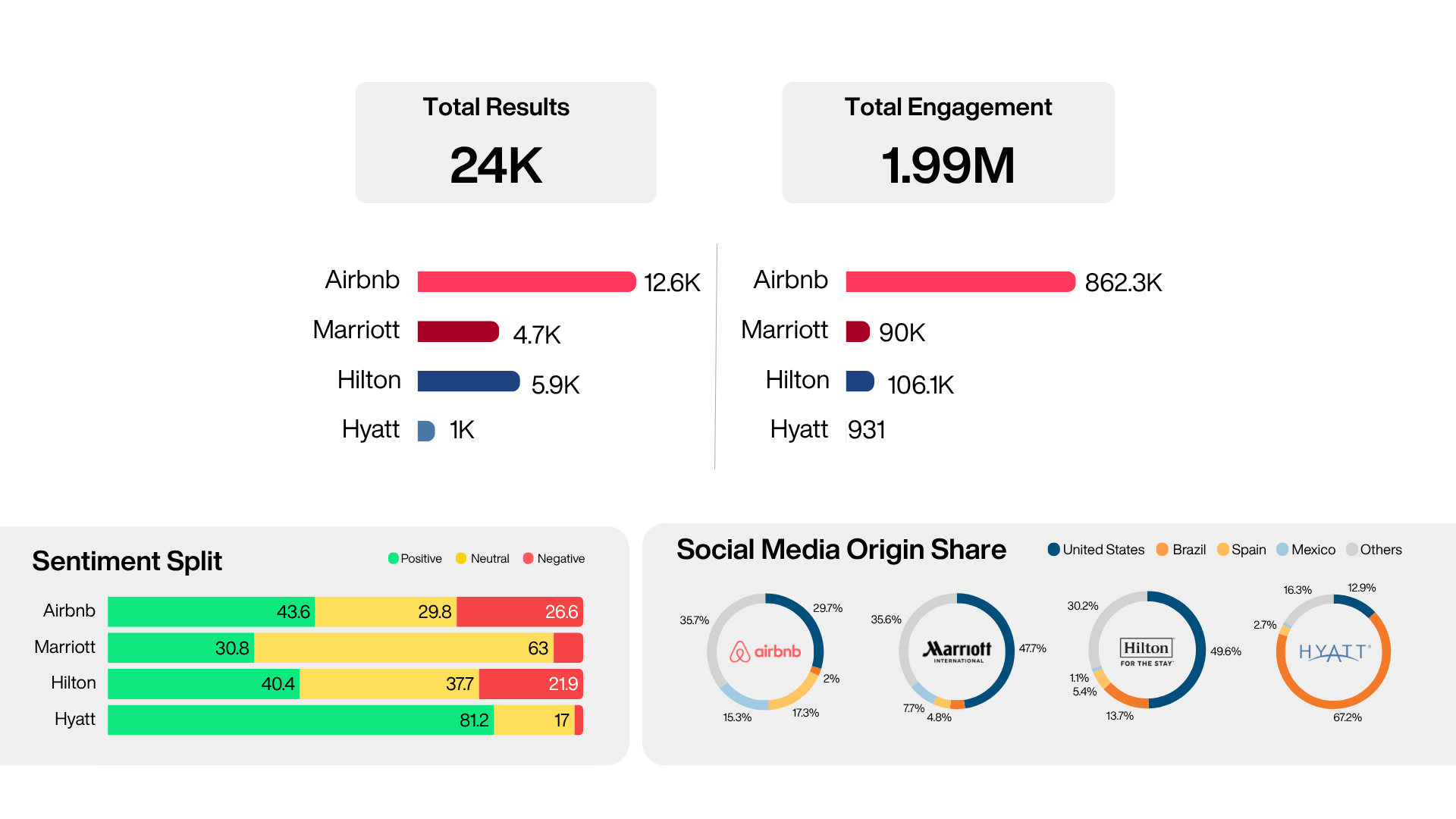
On social, the strongest stories are not just about rooms — they are about access, fandom and experiences.

  • Airbnb leads both conversation volume and engagement, making it the strongest social performer overall.
  • Hilton and Marriott show mid-level visibility, with steady but less dominant traction.
  • Hyatt has the weakest social footprint, with the lowest mentions and only 931 engagements. With limited distinctive brand traction and no standout World Cup narrative, Hyatt is mostly folded into wider hotel conversations and travel logistics.
  • Sentiment differs by brand role: Airbnb faces more safety-related scrutiny, with hotels often seen as more secure than short-term rentals; Hilton’s negative sentiment is more issue-led, driven by labour disputes; and Marriott’s official sponsorship helps keep its conversation more neutral through fan-access and Marriott Bonvoy coverage.
  • Hyatt is the most positive brand by sentiment mix, but this should be read carefully because it is based on the smallest conversation pool.

Airbnb vs Hotels

Airbnb’s positioning benefits from flexibility, overflow capacity and a strong owned narrative — but the comparison needs caveats.

Commissioned Deloitte / Airbnb estimates
2.7M Airbnb guest nights | $1.2B direct guest spending |
$212M host earnings | 34,770 FTE jobs supported
 

Comparison Takeaways

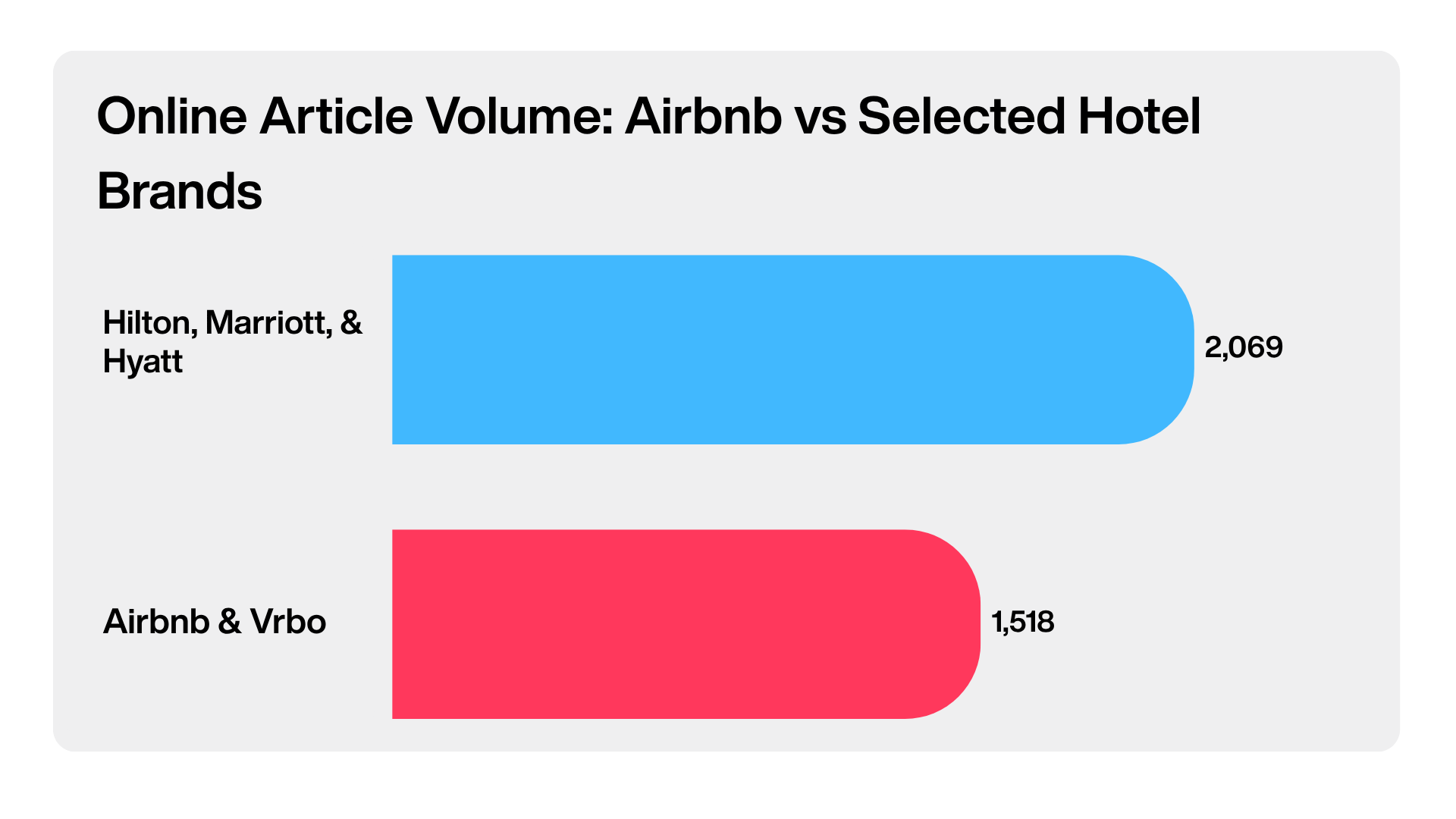
  • Short-term rentals have fewer mentions than hotels, but the gap is relatively small: 1,518 vs 2,069 articles.
  • Short-term rentals generated around 73% of hotel article volume, despite hotels being the more established and expected part of World Cup travel coverage.
  • This is notable given the scale of the tournament: the 2026 World Cup spans 48 teams and 16 host cities across North America, creating accommodation demand across a much wider geographic footprint than a typical single-country tournament. (FIFA)
  • This is a positive signal for Airbnb and Vrbo because they are competing strongly in the accommodation conversation, not sitting as a niche alternative.
  • Hotels remain the traditional option for teams, officials, sponsors and fans, but short-term rentals are now central to the World Cup accommodation narrative because they can absorb demand across more neighbourhoods than traditional hotel corridors.
  • Airbnb is actively leaning into this role, offering a $750 new-host reward for eligible entire-home hosts in World Cup event zones, showing a clear supply-side push around the tournament. (Airbnb Newsroom)
  • The Deloitte and Airbnb figures reinforce this positioning, with the study estimating 2.7M Airbnb guest nights, $1.2B direct guest spending, $212M host earnings and 34,770 FTE jobs supported. (Deloitte / Airbnb)

Source note: Deloitte Finance, “The Role of Airbnb in the FIFA World Cup 2026”, prepared at Airbnb’s request.

Macro Theme Map

World Cup accommodation discussions were shaped more by risk, cost, and convenience than by traditional hospitality experiences.

Narrative Implications
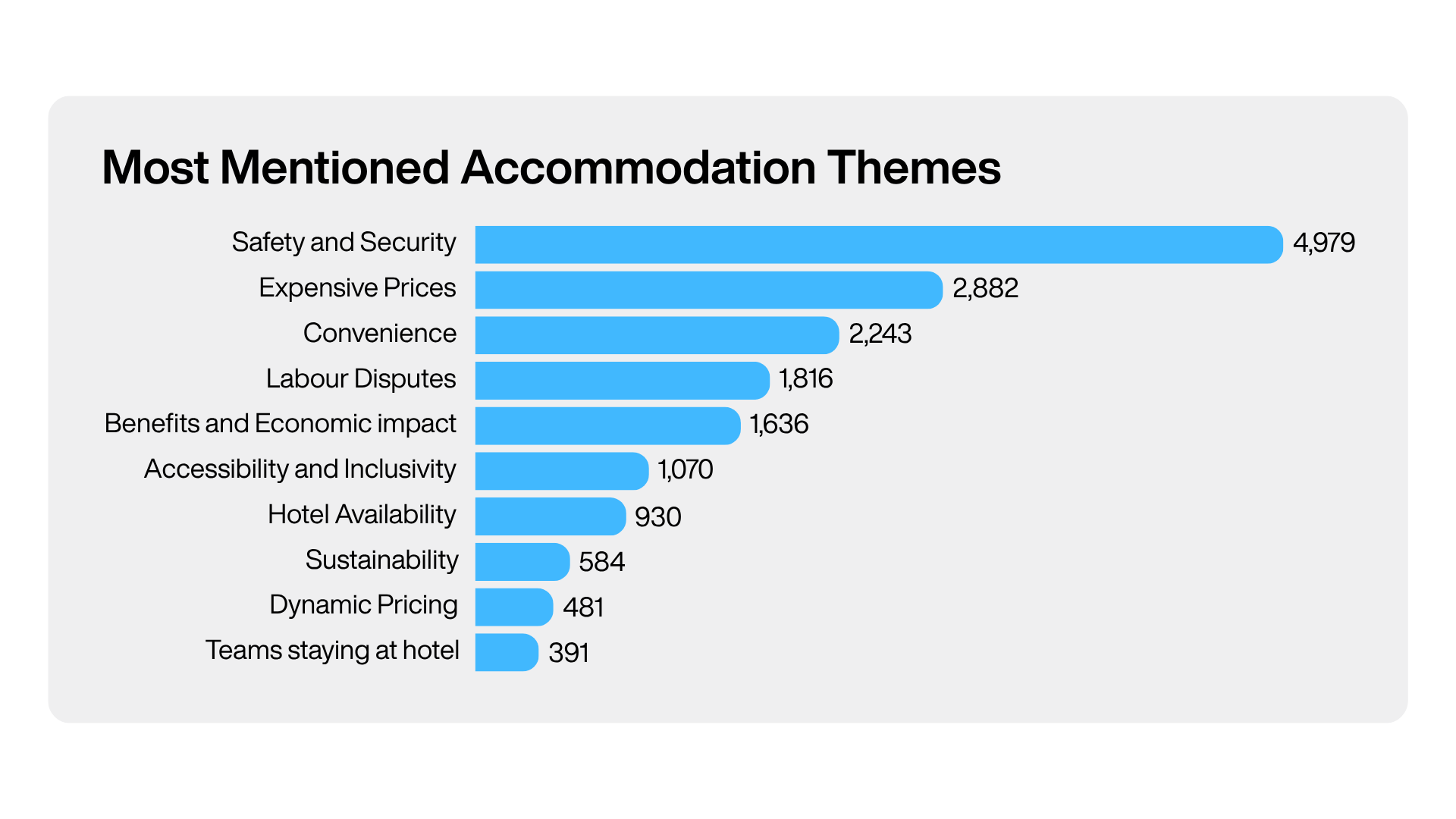
  • Safety and security dominated the accommodation conversation, driven by concerns around personal safety, neighbourhood risk, organised crime, crowd management, immigration controls, and the wider security environment in host cities. Accommodation was often discussed through the lens of risk rather than hospitality.
  • Affordability was the second-largest theme, reflecting frustration around the high cost of attending the World Cup. Accommodation rates were frequently discussed alongside ticket prices and travel expenses, contributing to a broader narrative around the overall expense of major sporting events.
  • Convenience emerged as a key driver of accommodation choice, with proximity to stadiums, fan zones, airports, and public transport consistently highlighted as a priority for travelling fans navigating host cities.
  • Labour disputes created a visible risk narrative for hotels, with discussion centred on worker strikes, union action, contract negotiations, and concerns around operational readiness and potential disruption during the tournament period.
  • Economic impact generated a mixed narrative. While some coverage highlighted increased revenues for hotels, local businesses, host cities, and the wider accommodation sector, other discussions questioned whether the expected tourism boost and economic uplift were fully materialising.

So, how do these big accommodation themes play out for each brand?

Airbnb - Top Online Media Themes

Airbnb owns the widest narrative footprint: convenience and economic upside on one side, regulation and safety pressure on the other.
Online Newspaper Readout

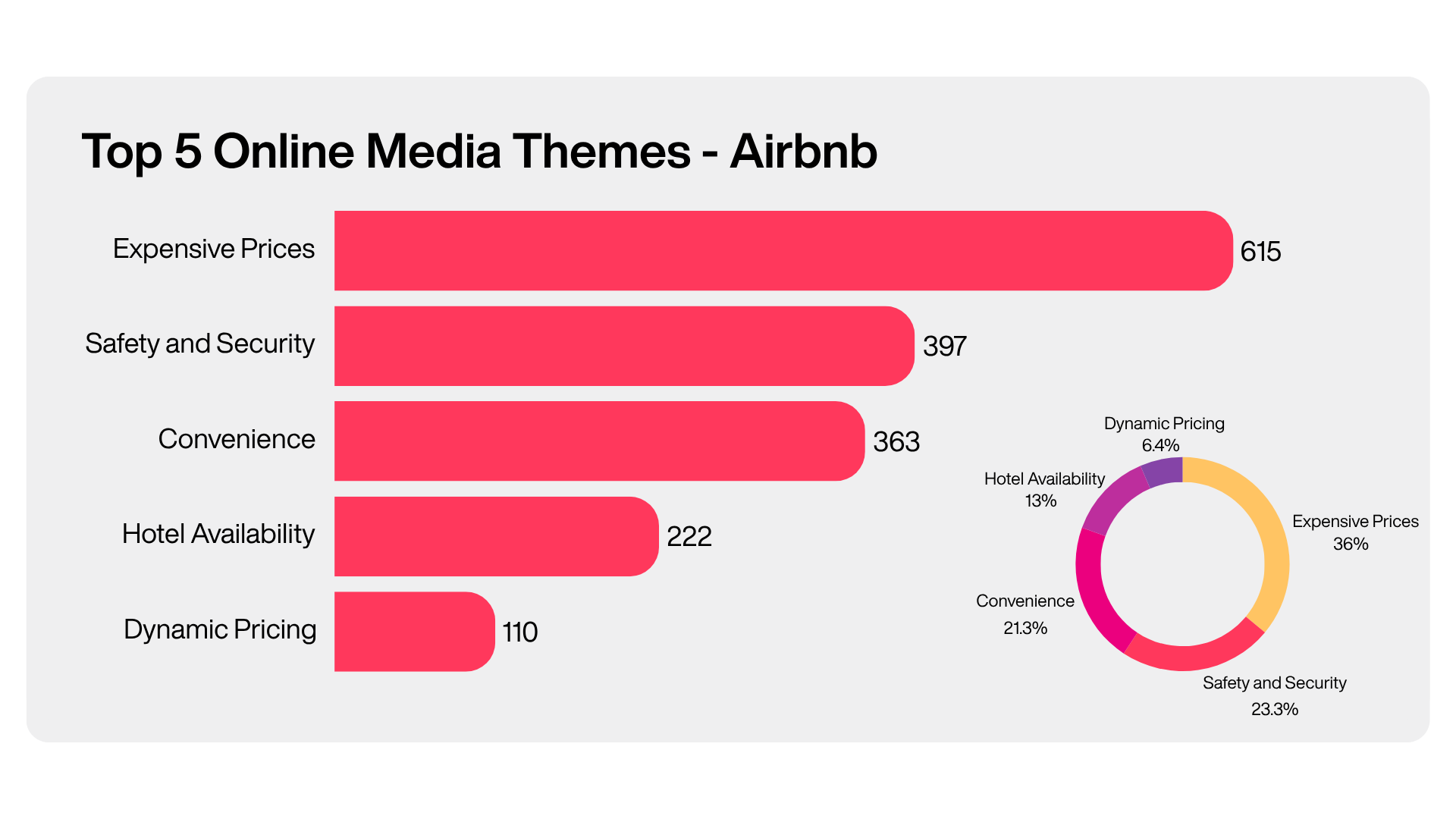
  • Airbnb’s mentions is led by Expensive Prices (615 mentions), with coverage focused on high prices, short-term rental rate spikes near stadiums and wider fan frustration. In some extremes, hosts were reported to be charging up to 1,500% above normal rates. (New York Post)
  • However, the pricing story is not entirely negative. Airbnb data shows that 77% of available entire-home listings and 86% of booked entire-home listings were under $500 per night, supporting its value narrative for groups splitting larger properties. (Airbnb Newsroom)
  • Safety and Security (397 mentions) is the second-largest theme, placing Airbnb within host-city risk concerns, organised crime, neighbourhood safety, scams, visitor protection and immigration-control anxieties. ICE-related discussion also appeared in Los Angeles, where labour groups linked enforcement concerns with calls for FIFA to distance itself from Airbnb. (The Guardian)
  • Convenience (363 mentions) gives Airbnb its clearest positive utility story, with short-term rentals framed as flexible options near stadiums, public transport and fan activity, while also offering access to lower-cost areas further from venues.
  • Hotel Availability (222 mentions) reinforces Airbnb’s role as overflow accommodation within the wider World Cup housing infrastructure, with Deloitte estimating 2.7M Airbnb guest nights during the event. (Deloitte / Airbnb)


Social Media Readout

  • Positive coverage was fan-led, with Airbnb acting as a setting for World Cup celebrations, guest-host interactions and creator-led football content.
  • The Scottish “Tartan Army” guest-host story generated 1.9k mentions, around 15% of Airbnb’s 12.6k total World Cup social mentions, driven by Airbnb guests connecting with resident Mike Morrison.
  • High-profile and football-personality content also generated 1.9k mentions (15% of total Airbnb mentions), adding a brand-building layer around watch parties, fan experiences, and football entertainment.
  • Neutral and negative conversation focused on softer demand, regulation, security concerns, price fluctuations, vacancies and wider frustration around the cost of attending the World Cup.

Representative Headlines

Airbnb is handing out free World Cup tickets — as FIFA’s pricing meltdown leaves thousands unsold – NEW YORK POST

FIFA World Cup 2026 Airbnb Data: How the Group Draw Reshaped STR Demand – airroi

Hilton - Top Online Media Mentions

Hilton’s World Cup positioning is driven by operational visibility rather than brand activation, with Spain’s team stay creating buzz while labour disputes add reputational pressure.
Online Newspaper Readout

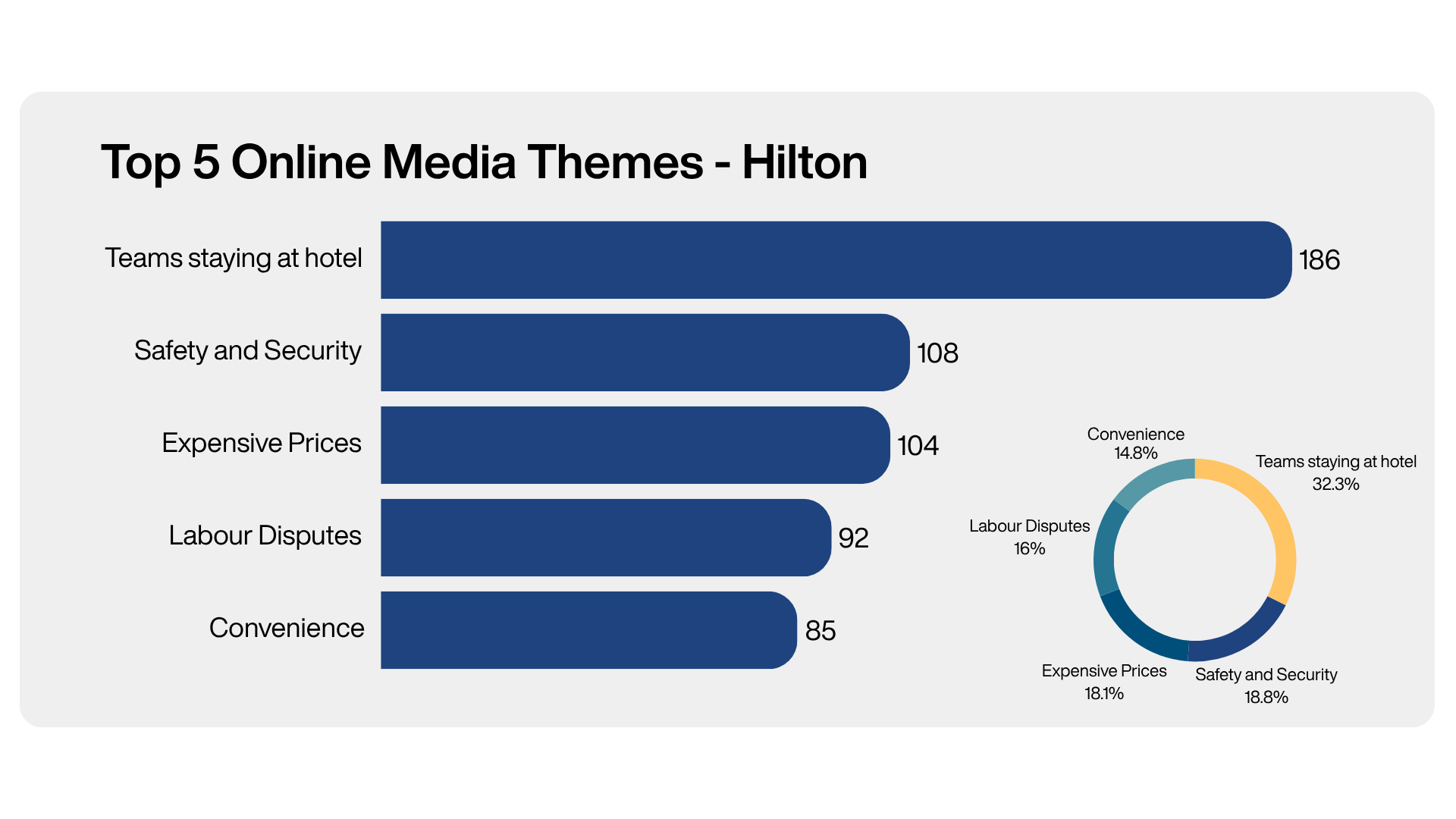
  • Hilton’s online media profile is led by team accommodation (186 mentions), with Spain’s stay at Embassy Suites by Hilton Chattanooga Downtown creating the clearest brand-specific story. This is especially impactful because Marriott generated only 25 team-stay mentions, roughly one-seventh of Hilton’s volume. Despite Marriott being linked to more team stays, Hilton is winning the media narrative because Spain has been consistently ranked within FIFA’s top two teams since the World Cup started, making its stay a stronger quality-over-quantity story.
  • Wider coverage places Hilton within the tournament’s hotel infrastructure, while Safety and Security (108 mentions) and Expensive Prices (104 mentions) help explain softer-than-expected demand. Expensive prices act as a direct barrier to bookings, while broader security concerns create an indirect drag by making some fans more cautious about travel and accommodation choices. This aligns with AHLA reporting that around 80% of hoteliers in major U.S. cities saw lower-than-expected World Cup bookings. (AHLA)
  • The main reputational risk comes from Labour Disputes (92 mentions), particularly the Seattle Embassy Suites dispute, where 94% of union members voted in favour of strike action ahead of the tournament. (The Seattle Times)

Social Media Readout

  • Social conversation adds a fan-led layer, with the Spain team stay generating 1.1k mentions, equal to around 19% of Hilton’s total World Cup social mentions. This was driven by hundreds of fans gathering at Embassy Suites by Hilton Chattanooga Downtown to welcome the team.
  • Practical travel discussion was mostly neutral, with users focusing on hotel locations, stadium access, transport links and accommodation planning.
  • Negative social posts were more issue-led than experience-led, with the Seattle Embassy Suites labour dispute generating 1.3k mentions, equal to around 22% of Hilton’s total World Cup social mentions. These posts focused on worker rights, strike action and host-city readiness.

Representative Headlines

Seattle hotel workers authorize strike ahead of World Cup – The Seattle Times

“Chattanooga to Host Spain’s Men’s National Team at 2026 FIFA World Cup” – News Seattle Nine

“New Report Warns World Cup Hotel Boom May Fall Short of Expectations – AHLA

Marriott - Top Online Media Themes

Marriott stands out among hotel brands with a more deliberate, marketing-led World Cup narrative and a stronger brand narrative.
Online Newspaper Readout

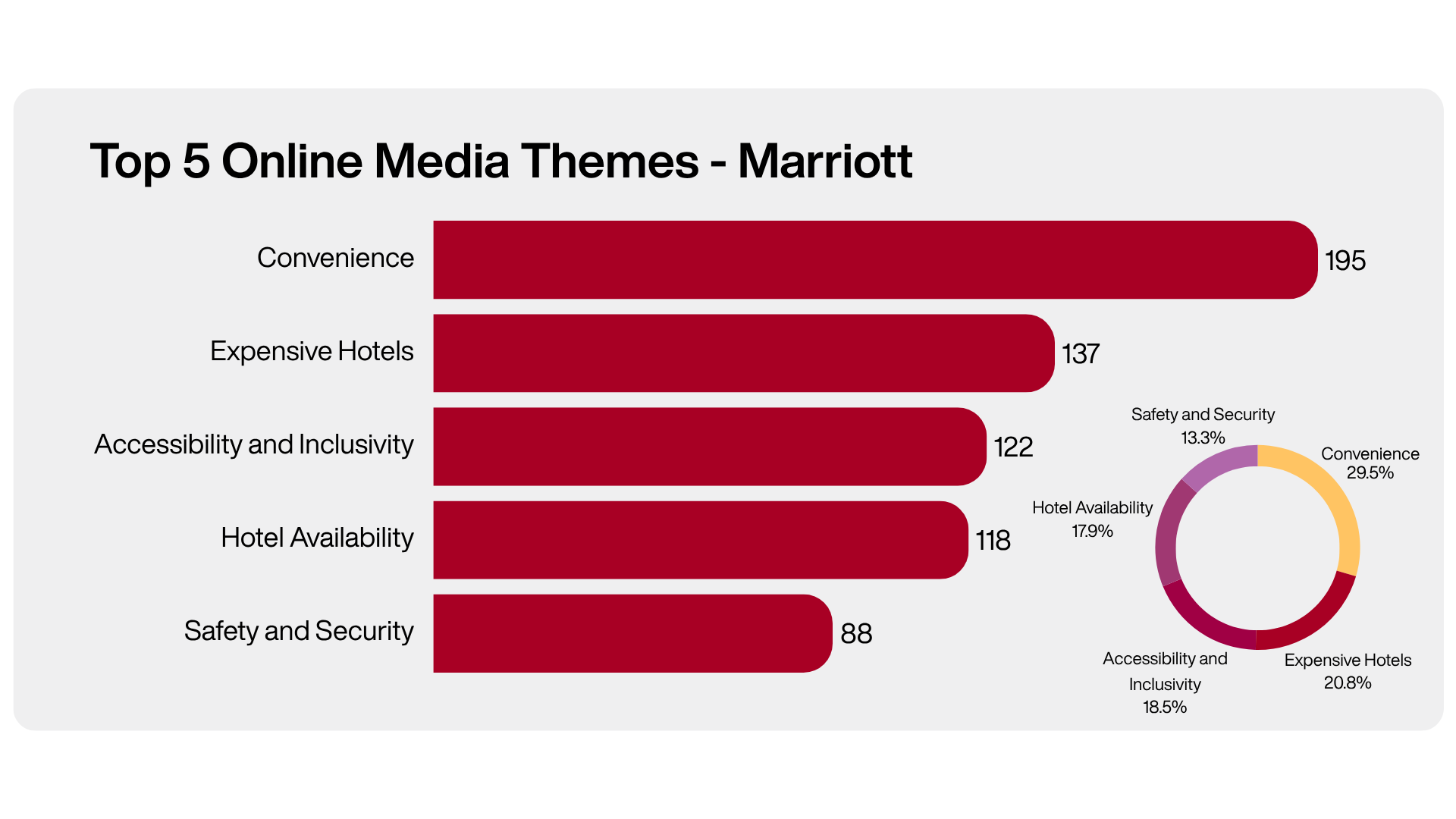
  • Marriott’s online media profile is led by Convenience (195 mentions), with coverage positioning Marriott Bonvoy as the most deliberately activated hotel brand in the World Cup accommodation conversation. As an Official Hotel Supporter, its “For Fans, Everywhere” campaign links match access and Marriott Bonvoy Moments across 104 matches, three host countries and 16 host cities. (Marriott)
  • Expensive Hotels (137 mentions) places Marriott in the same wider World Cup cost-pressure context as Hilton, rather than as a Marriott-specific issue.
  • Accessibility and Inclusivity (122 mentions) connects to Marriott’s fan-access and family-travel positioning. Marriott and Visa’s campaign gives members access to ticket-linked experiences, while the tournament spans 48 teams, 104 matches and 39 days, creating a major travel occasion for families, groups and international fans. (FIFA)
  • Hotel Availability (118 mentions) reflects a tougher market backdrop. While Marriott benefits from official hotel infrastructure, wider hotel demand has been softer than expected, with FIFA reportedly cancelling large room blocks, including 2,000 rooms in Philadelphia and 800 in Mexico City. Kansas City coverage also reported cancellations of around 75% of FIFA’s reserved rooms. (The Sun)
  • Safety and Security is the fifth-largest theme, placing Marriott in a similar context to Hilton within the wider World Cup accommodation safety conversation around team stays, fan travel and host-city readiness.

Social Media Readout

  • Positive conversation was led by Iran’s World Cup preparations in Tijuana, as the team base and local fan focal point. The story generated 478 mentions, around 10% of Marriott’s 4.7k total mentions.
  • Ticket giveaways and Marriott Bonvoy promotions strengthened Marriott’s fan-access story, generating 331 mentions, around 7% of total mentions.
  • Neutral conversation focused on team hotel arrangements, travel planning and tournament logistics.
  • Negative conversation centred on hotel pricing frustration, including rate drops after booking and hotels not honouring lower prices.

Representative Headlines

Marriott Bonvoy to provide unmatched fan access to FIFA World Cup 2026 – FIFA

Visa x Marriott Bonvoy FIFA World Cup 2026 Sleepover Suite Sweepstakes – MoneysMyLife

Hyatt - Top Online Media Themes

Hyatt is discussed through logistics and pricing dynamics rather than a distinctive brand campaign.
Online Newspaper Readout

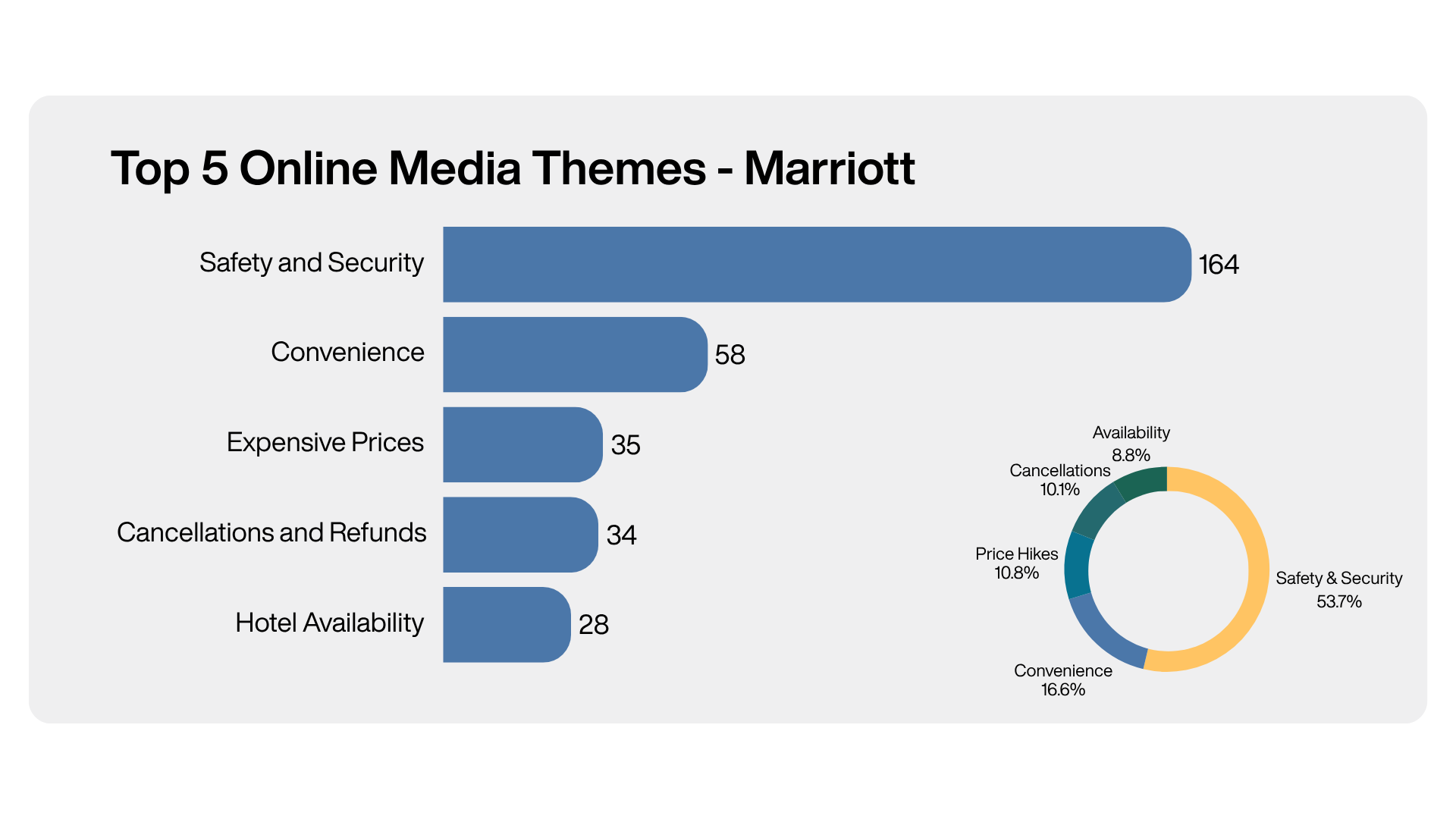
  • Hyatt’s online media profile is dominated by Safety and Security, with 164 mentions, accounting for 53.7% of its top-five theme mix. This places Hyatt within the wider World Cup accommodation-risk conversation, where hotels are discussed as part of host-city readiness, secure stays and traveller confidence. This is reinforced by $625M in U.S. host-city security funding and coordination across 400+ law enforcement agencies, including planning around stadiums, fan festivals, team hotels, base camps and transport hubs.
  • Convenience is the second-largest, with 58 mentions, but remains almost three times smaller than Safety and Security, showing that Hyatt is discussed more through practical travel logistics than fan experience.
  • Cancellations and Refunds and Hotel Availability are smaller themes, with 34 and 28 mentions respectively, suggesting Hyatt’s coverage is fragmented across general hotel-market concerns.
  • Hyatt had the lowest overall visibility in online newspaper coverage, accounting for only 9%.
  • On social, Hyatt also had the lowest brand volume, with 1k mentions versus 12.6k for Airbnb, 5.9k for Hilton and 4.7k for Marriott.

Social Media Readout

  • Hyatt’s social conversation is mostly practical and travel-led, with users asking how to get from hotels such as Hyatt Regency LAX and Hyatt Regency Boston to World Cup venues using metro, shuttles, trains, buses and Uber.
  • Hotel planning was another key theme, with users discussing Hyatt properties near airports, stadiums and transport hubs, including check-in times, proximity to South Station and ease of match-day travel.
  • Positive and neutral conversation largely overlapped, showing that Hyatt was viewed less through emotion or brand activation and more as a useful accommodation option within fan travel planning.
  • Broader World Cup preparation content added context around hospitality, staffing, security, shuttle services, stadium updates and the expected $40B+ tournament impact.
  • Negative conversation focused on practical challenges, including high hotel prices, limited availability, parking issues and difficult logistics in cities such as Los Angeles, Dallas and Atlanta.

Representative Headlines

How Airports Are Welcoming FIFA World Cup 2026 Travelers – UPGRADEDPOINTS

FIFA canceled 75% of reserved rooms months before World Cup, no penalty fees paid – 41KSHB

Let’s continue the conversation.

This report provides a snapshot of how leading hospitality brands are using the FIFA 2026 World Cup to shape media narratives and visibility.

This report analyses online media coverage from North America and the UK between 1 May 2026 and 16 June 2026. The dataset includes articles where the World Cup is mentioned in the headline and features as a prominent topic within the coverage. Analysis focuses on coverage volume, sentiment, engagement and key narrative themes across relevant brand and tournament mentions.

For organisations looking to understand the full communications impact of major events, from sponsorship ROI and narrative performance to spokesperson influence and campaign effectiveness, CARMA helps brands understand how sponsorship translates into narrative dominance, reputation impact and commercial influence.

To learn more about how we can support your communications and marketing strategy, please contact Chadwick Rubin in the US or Michael Simpson in the UK.

Edition 1:
Accommodation

Download the full analysis as a PDF Report!