
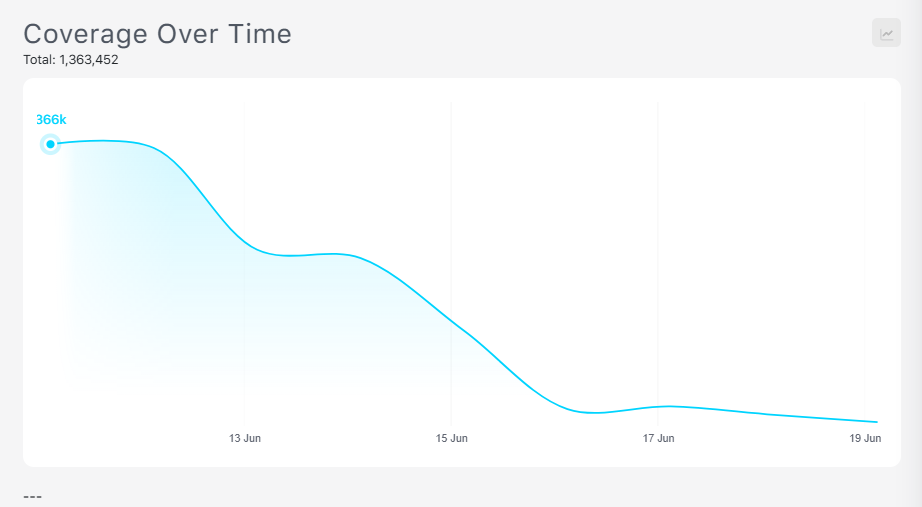
The opening two days (Jun 11–12) produced the week’s peak, each surpassing 360,000 articles, as the first wave of fixtures captured global attention. Volume tapered through the mid-week before settling into a lower baseline by Jun 18–19.
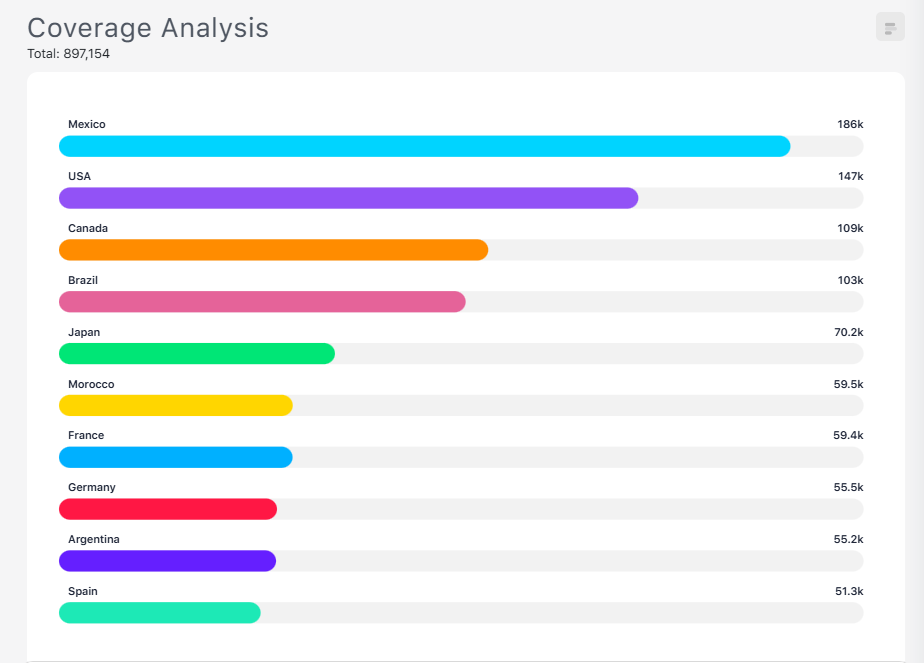
Mexico leads all team coverage by a wide margin, followed by the USA and Canada; all three host nations commanding outsized attention driven by opening fixtures, not just tournament status. Japan’s 70,200 articles place it 5th overall, ahead of Morocco, France, Germany, Argentina, and Spain.
Host nations dominate the early World Cup conversation, with Mexico leading team visibility after becoming the first nation to take the field and featuring in the tournament’s opening match against South Africa. The USA and Canada complete the top three, highlighting the strong visibility advantage associated with hosting the competition.
Brazil and Japan are the most prominent non-host nations, while Argentina’s ranking suggests that much of the conversation is being driven by Lionel Messi as an individual rather than by the team itself.
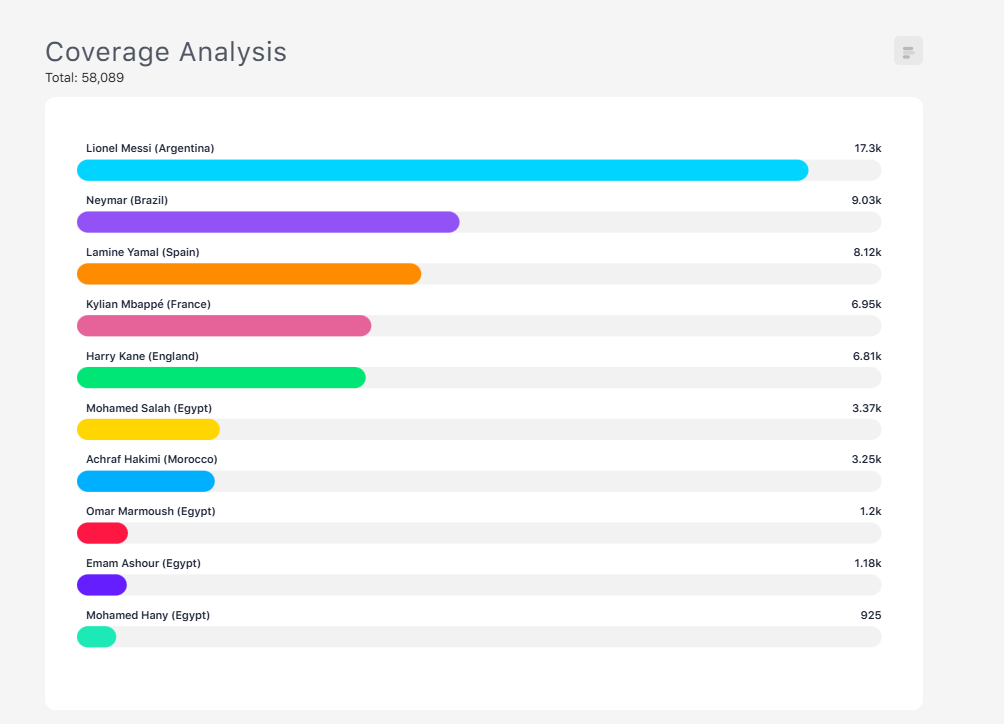
The player conversation is currently being driven as much by reputation, expectation and selection narratives as by performances on the pitch. As the tournament progresses, match impact is likely to become the dominant driver of player visibility.
Player visibility during the opening week reflects a mix of legacy, expectation and emerging talent narratives. Lionel Messi leads the conversation, driven by his historic status and record sixth World Cup campaign, while Mohamed Salah carries the weight of national expectations as Egypt’s most influential player. Neymar’s return from injury has generated significant attention, positioning him as one of the tournament’s key comeback stories, while Kylian Mbappé continues to attract coverage as the player expected to lead France’s title ambitions.
Meanwhile, a new generation of talent is beginning to shape the narrative. Lamine Yamal’s status as one of football’s brightest young stars has strengthened his breakout storyline. Achraf Hakimi completes the top group, combining both legacy and expectation as Morocco’s captain and one of the leading symbols of African football on the global stage.
While host-nation fixtures and global football brands dominated early coverage, player-driven storylines proved equally influential in determining which matches generated the highest levels of media attention.
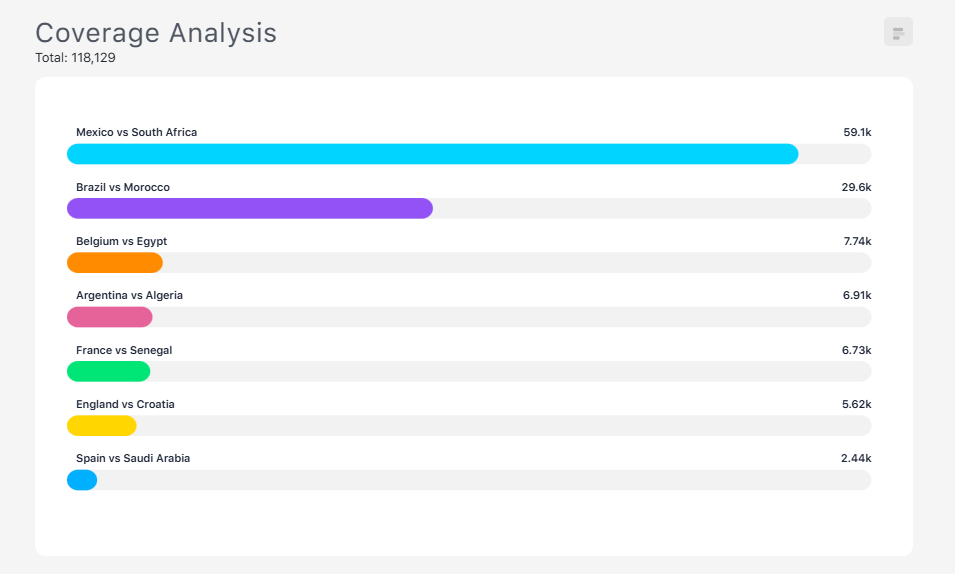
Match visibility during the opening week was heavily concentrated around high-profile fixtures and key tournament narratives. Mexico vs South Africa generated the highest volume of coverage, reflecting its significance as the opening match of the FIFA World Cup 2026 and the first game of the expanded 48-team tournament. Brazil vs Morocco followed closely behind, driven by the global appeal of two nations with passionate fan bases and strong international media interest.
Belgium vs Egypt also attracted significant attention, helping to explain the strong visibility of several Egyptian players in the overall player rankings.
Argentina vs Algeria rounded out the most discussed fixtures, with much of the coverage centred on Lionel Messi. The strong alignment between match visibility and Messi’s individual mention volume suggests that his prominence during the week was driven not only by his status as a global football icon, but also by his direct impact on the pitch.
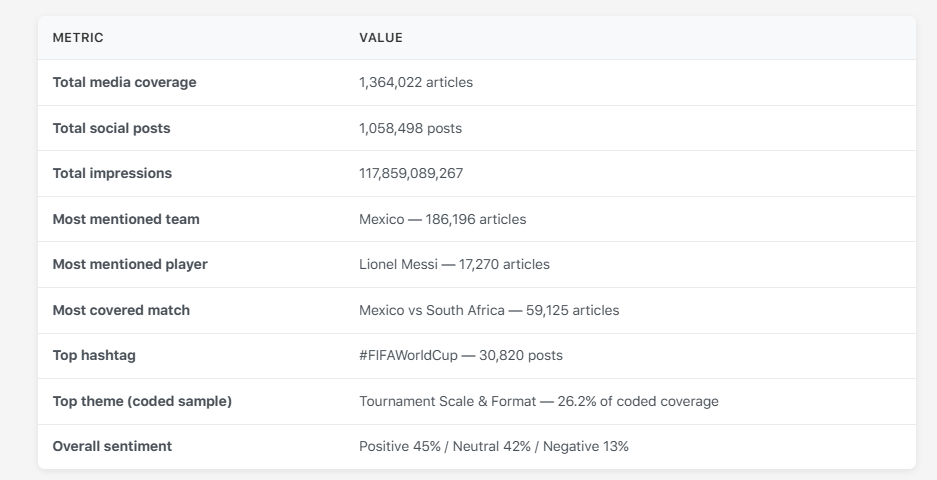
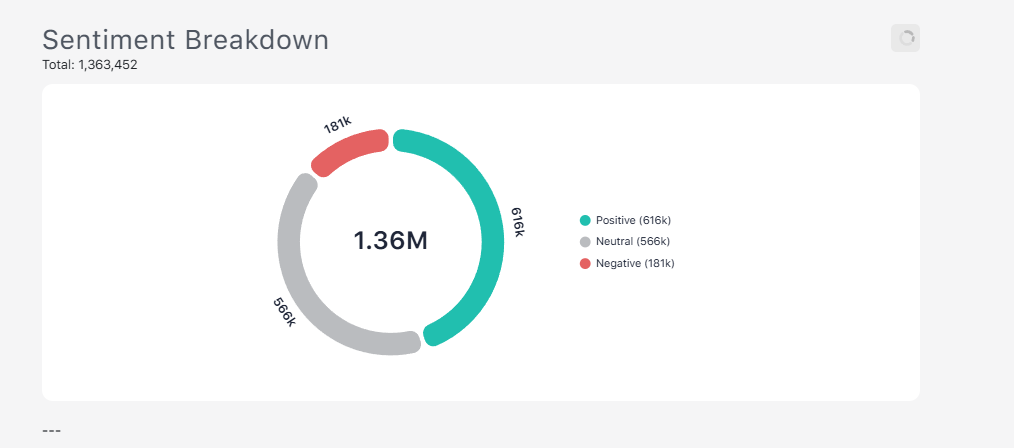
The overall sentiment split across the 9-day window shows positive coverage leading at 45%, with neutral at 41% and negative at 13%. Positive significantly outpaces neutral, driven by the excitement and celebration surrounding tournament kick-off.
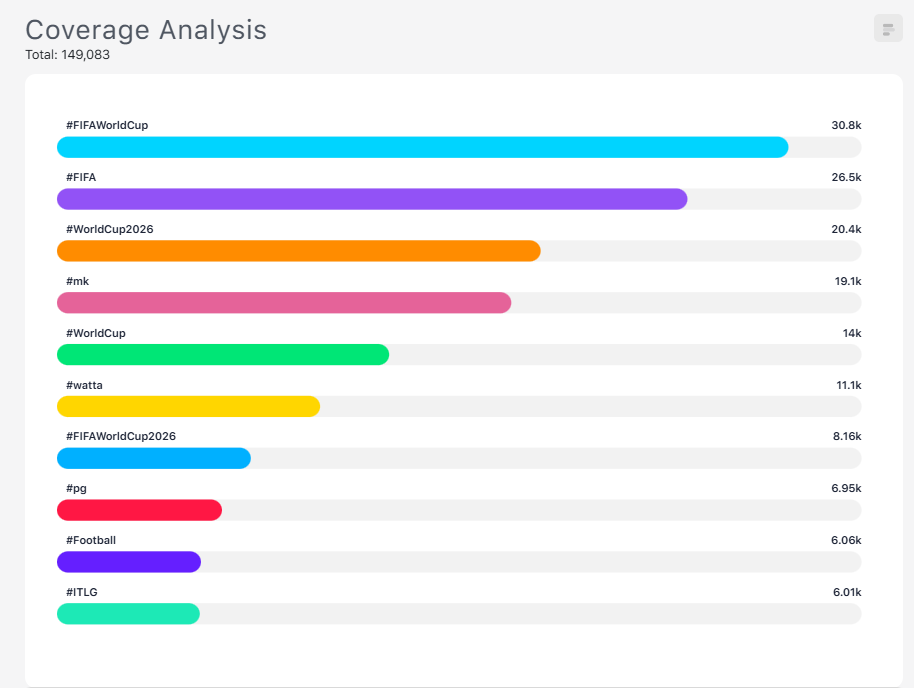
#FIFAWorldCup leads social conversation with 30,799 posts, followed by #FIFA (26,546) and #WorldCup2026 (20,365) reflecting a broader, more globally distributed hashtag set.
Governance flashpoints outpaced on-pitch celebration in editorial weight.
For Teams brands and household names, the risk environment is real, association with access controversies or geopolitical tensions can pull coverage into negative territory quickly.
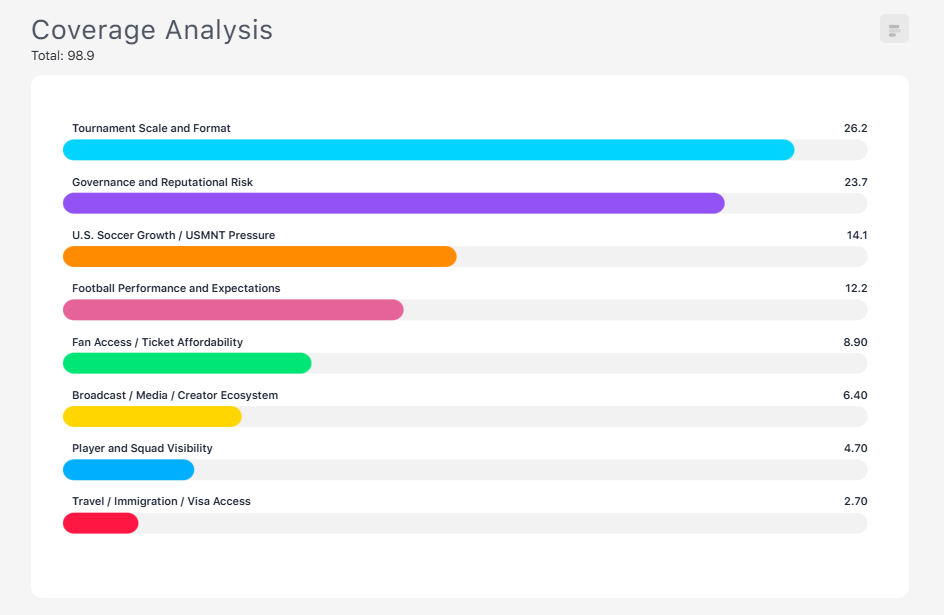
Tournament Scale and Format (26.2%) dominated the opening week. The 48-team, 3-nation format was framed as historic across global media, with broad international reach through match previews and cultural angles tied to the tournament’s unprecedented scale.
Governance and Reputational Risk (23.7%) was the week’s most sensitive cluster. The US revocation of Iran’s ticket allocation fused geopolitical tension with fan access. Iranian player Mehdi Taremi stated on camera: “We have a lot of problems. It’s so bad and it affects our team.” Mexico City protests blocking fan zones added a domestic dimension.
U.S. Soccer / USMNT Pressure (14.1%) reflected the host-nation paradox. The US 4–1 win over Paraguay generated positive social momentum, but broader coverage held the USMNT to a higher standard given co-host status; A pattern confirmed by the fixture’s article volume.
Football Performance and Expectations (12.2%) was driven by match reactions and squad narratives. Japan’s draw with the Netherlands (14,725 articles) was among the standout results of the opening round.
Fan Access / Ticket Affordability (8.9%) remained a persistent undercurrent, amplified by the Iran visa story and domestic protests in Mexico.
Broadcast / Media / Creator Ecosystem (6.4%) reflects the growing creator economy around the tournament, with social platforms and streaming associations visible in the hashtag data.
Player and Squad Visibility (4.7%) while lower as a coded theme share, live data shows Messi alone generated 17,268 articles, underscoring how individual star power concentrates rather than distributes attention.
Travel / Immigration / Visa Access (2.7%) remained the smallest cluster but carries disproportionate reputational weight given the Iran situation.
Methodology: This analysis is based on CARMA’s monitoring of FIFA World Cup 2026-related coverage across online news, print, broadcast, radio/podcasts where available and social media. Automated metrics include volume, reach/impressions, engagement, team mentions, player mentions, match mentions and hashtag visibility. Qualitative findings are based on sample-coded coverage, including relevance, theme, sentiment, prominence and issue influence. Percentages are indicative of the coded sample, not total global coverage.
Date range analysed: 11–19 June 2026 | Stage: Pre-tournament build-up Markets covered: Global, with U.S. deep dive Data sources: Online news, print, broadcast, radio/podcasts, and social (X/Twitter, Instagram, TikTok, YouTube, LinkedIn).