
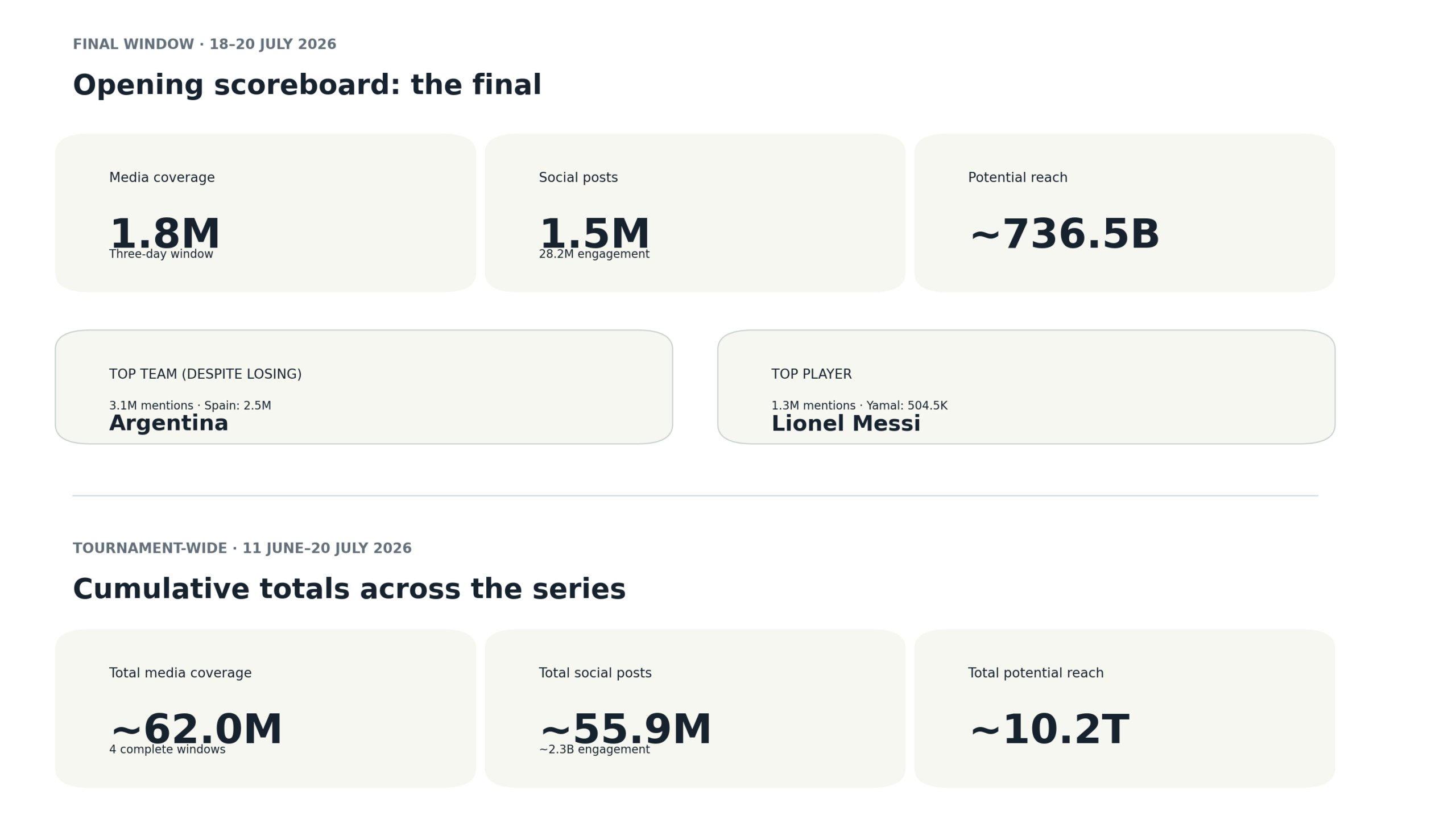
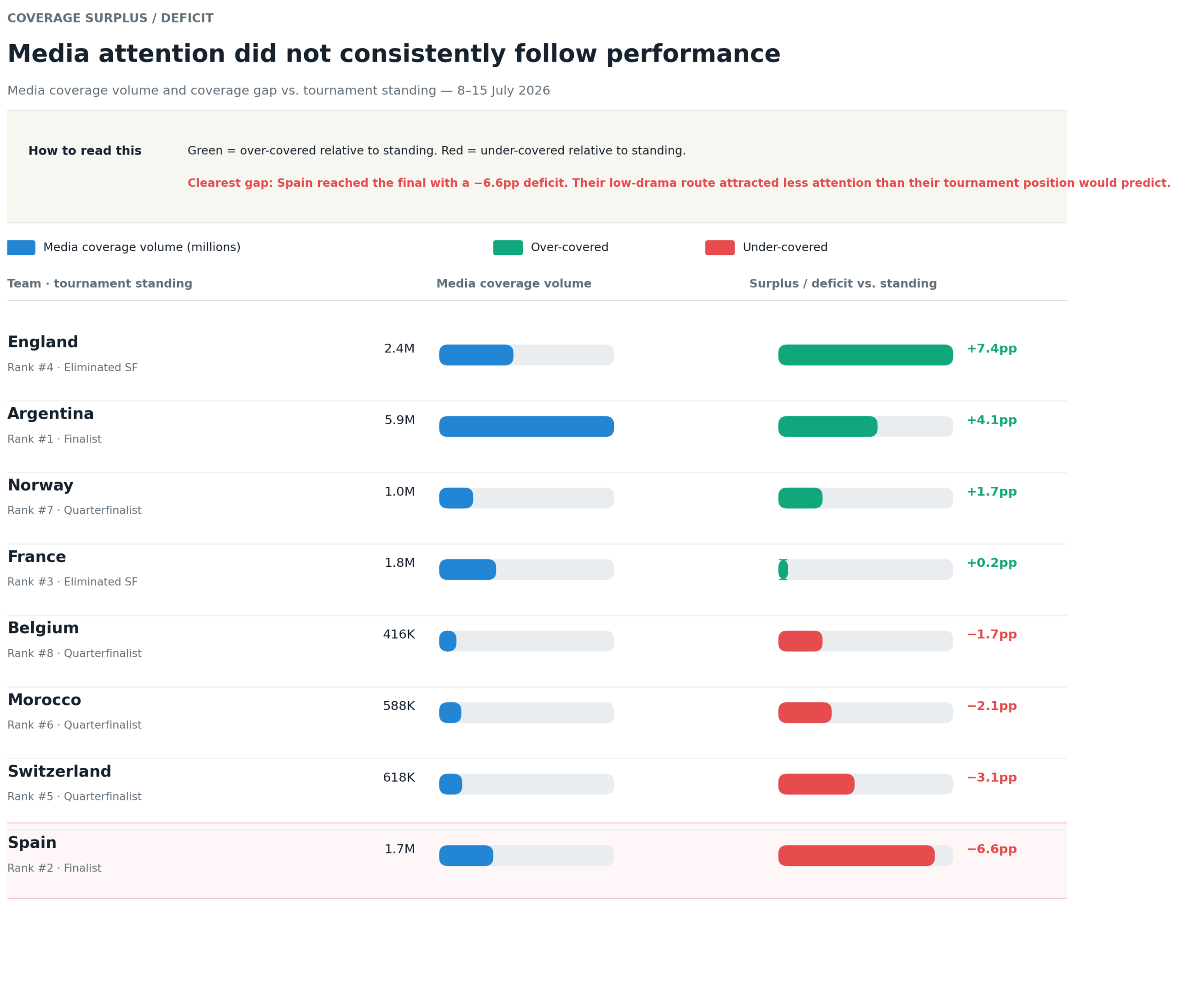
Spain is the clearest coverage deficit this project tracked all tournament, and they’re the team that won it. Heading into the final, Spain ranked fourth in the 8–15 July coverage leaderboard while sitting second in tournament standing, a -6.6 percentage-point gap. They then won the trophy, and Argentina still out-mentioned them in the final window.
This closes out a pattern that ran through the entire knockout stage. France carried the tournament’s largest coverage deficit in the quarterfinal week despite topping the standings. Spain carried the second largest the following week, despite reaching the final. Both were efficient, low-drama, low-controversy campaigns. Argentina, by contrast, needed a stoppage-time or extra-time goal in four consecutive knockout matches; Cape Verde, Egypt, Switzerland, England; and their coverage volume reflected the drama, not just the results. England, eliminated in the semifinal, still carried a +7.4pp coverage surplus that same week. Winning quietly was under-covered all tournament. Losing loudly, or nearly losing before somehow winning was over-covered every single week.
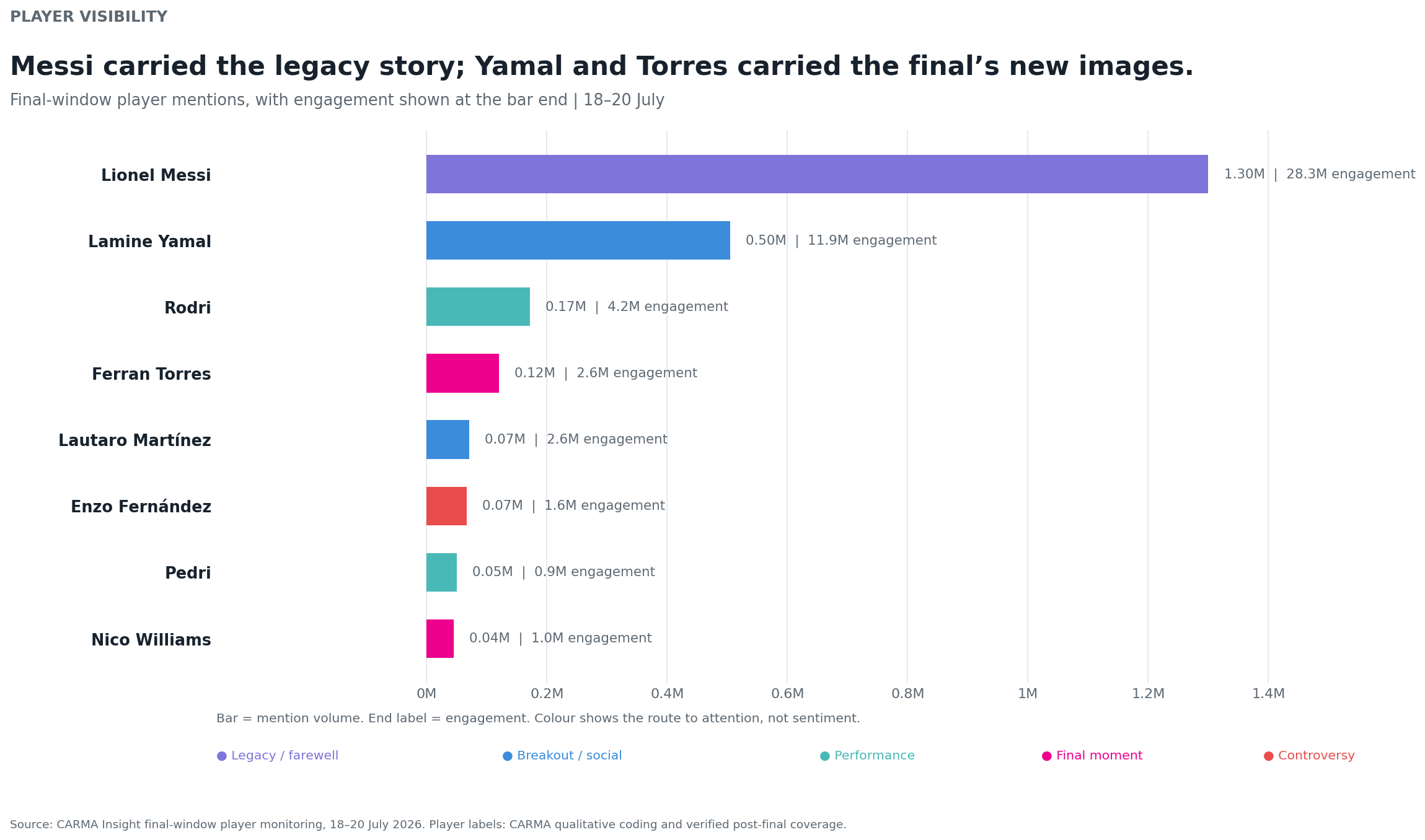
Messi led final-window player mentions at 1.3 million, more than double Yamal’s 504,500 in second place; the same legacy-versus-breakout shape this project identified as far back as the group stage, when Messi and Ronaldo shared headlines for opposite reasons. Messi’s coverage this week centred on the likely end of his World Cup career and a widely shared embrace with Yamal after the final whistle.
The Golden Boot result is the cleanest data point to close the “legacy vs. output” thread this series has followed all tournament. Mbappé’s ten goals beat Messi’s eight; decided not in the final, but in the third-place playoff four days earlier, where Mbappé scored twice in a 6-4 win nobody was covering as closely as the final itself. It’s a reminder of this project’s central finding “media attention and footballing output don’t always move together” but cuts both ways: sometimes the story with the least coverage attention (a third-place match) decides the outcome that gets debated for years.
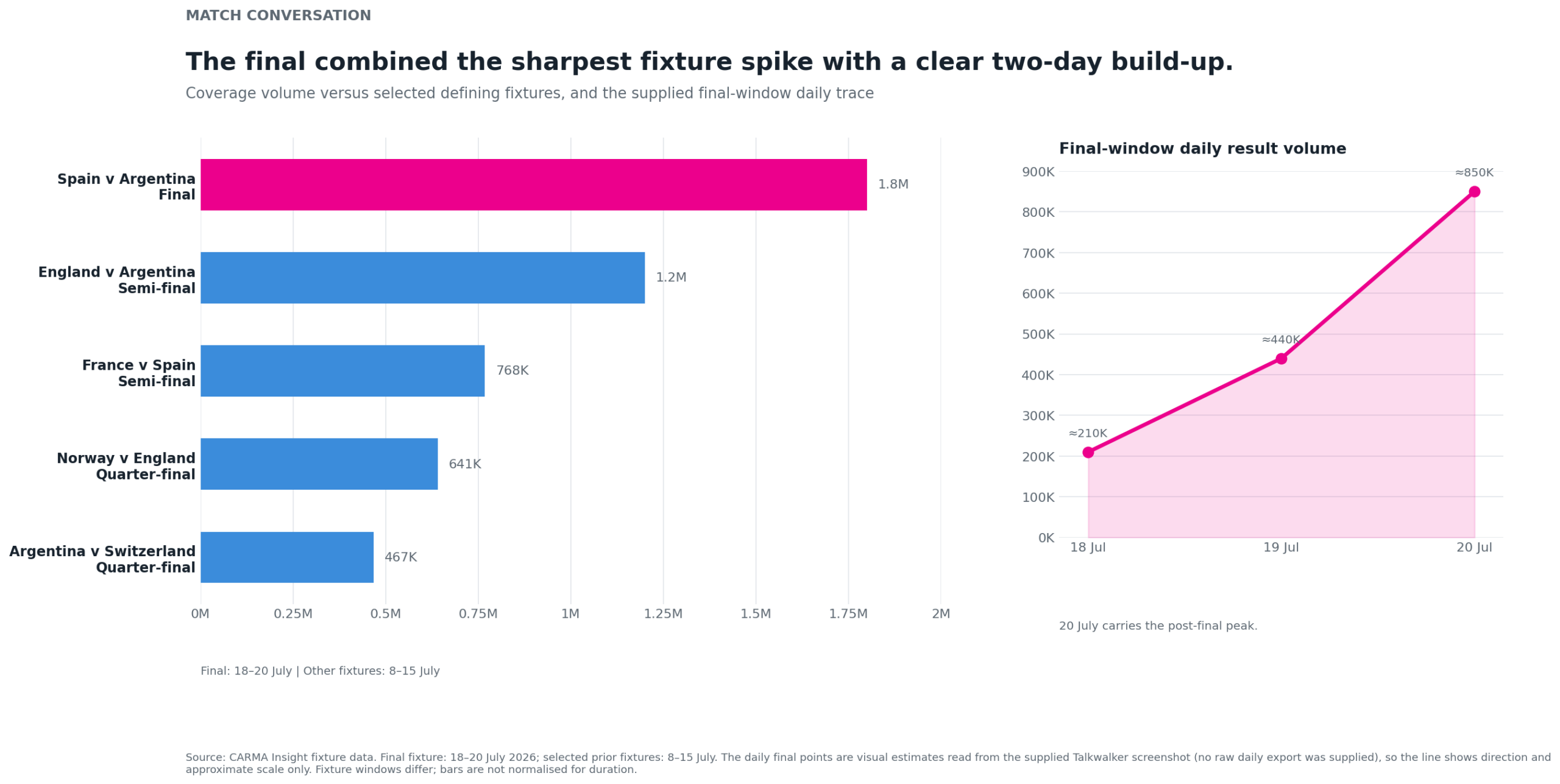
The final’s 1.8 million coverage items exceeded the 1.2 million recorded for England–Argentina, the series’ previous standout fixture.
The supplied final trend rises from 18 July into a clear 20 July peak. This was a short, decisive spike. England–Argentina built over several days on rivalry and then remained high after Argentina’s late comeback. The final won on peak volume; the semi-final won on narrative persistence.
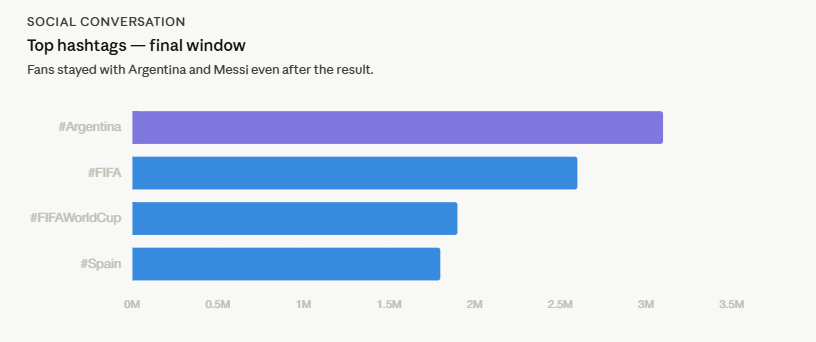
The final-window hashtag ranking puts #Argentina first at 3.1 million posts. It was followed by #FIFA at 2.6 million, #FIFAWorldCup at 1.9 million and #Spain at 1.8 million. Fans did not abandon Argentina after the result. They stayed with Messi, national pride and the emotional meaning of the final.
Mainstream coverage focused on Spain’s control, Torres’s finish, Fernández’s red card and Argentina’s lack of attack. Social coverage favoured scenes that travelled well: Messi and Yamal, the trophy lift, Spanish celebrations and Argentine defiance. Editorial outlets explained why Spain won. Fans shared what the final meant.

Football performance and results led the final-window coded sample at 44%. Player and team visibility followed at 39%. Together, they accounted for 83% of coverage. The final pulled attention back towards the contest and its protagonists.
Issue influence fell from 19% to 14%
A real decline, but not a clean exit. Of 118 coded issue-influence items, 82 were negative (69.5%), consistent with the 63–78% negative-concentration range this metric has held in every week it’s been tracked. Zooming out across the whole series, issue influence opened the tournament at 20%, fell to 12% and held there through the group stage, rose to 14% then 19% through the knockout rounds as the Balogun and Mbappé controversies compounded, and closed at 14%; declining, but not returning to its lowest point. Governance coverage was a real, sustained undercurrent of this tournament’s media story, not a single incident that came and went.
Mainstream coverage focused on Spain’s control, Torres’s finish, Fernández’s red card and Argentina’s lack of attack. Social coverage favoured scenes that travelled well: Messi and Yamal, the trophy lift, Spanish celebrations and Argentine defiance. Editorial outlets explained why Spain won. Fans shared what the final meant.
World Cup 2026 was defined by the gap between narrative power and tournament performance. Argentina owned the conversation through Messi, repeated late comebacks and the England rivalry. Spain’s route was efficient, controlled and often under-covered—until the final made that control the tournament’s lasting sporting achievement.
The final did not erase Argentina’s narrative lead. It settled the argument about the champion. Spain won the trophy; Argentina, and especially Messi, remained the most powerful media story.
Methodology: This wrap-up combines CARMA Insight monitoring supplied in the weekly reports with the final-window query for 18–20 July 2026. Any metrics showing cumulative totals or under the analysis time frame between the 11th of June to the 20th of July. Monitoring covers online news, print, broadcast and the specified social platforms. Media coverage, social-post volume, potential reach and engagement are reported as separate metrics.