
Opening Scoreboard, June 24 – July 1, 2026
The week generate 9.9 million media mentions as legacy and emotion still led the conversation, but a second axis opened up: redemption and institutional accountability.
Kane’s turnaround dominated player-level attention in a way that outpaced his earlier record-breaking week, because the “will he, won’t he” tension of a struggling captain rescuing his team reads differently to editors than a milestone alone. On the institutional side, the StubHub lawsuit gave the ticketing story something it had lacked all tournament: a concrete, escalating consequence rather than a recurring complaint.


Mexico leads the broader team conversation with 1.4 million mentions, supported by host-country energy, Guillermo Ochoa’s farewell, a 40-year knockout-curse-breaking win over Ecuador, and the continuing Merlin the duck story.
However, in the top-team coverage dataset, Japan is the largest single line item at 1.3 million mentions, followed by Brazil at 935,400, Mexico at 895,800, and Argentina at 873,100.
Coverage Surplus and Deficit
Each team’s actual share of top-team coverage was compared with an expected share based on inverse FIFA ranking weight.
Lionel Messi leads all players with 1.3 million mentions and 43.9 million engagements. Cristiano Ronaldo follows with 896,700 mentions and 32.3 million engagements. Both are record-driven, global, and editorially familiar.
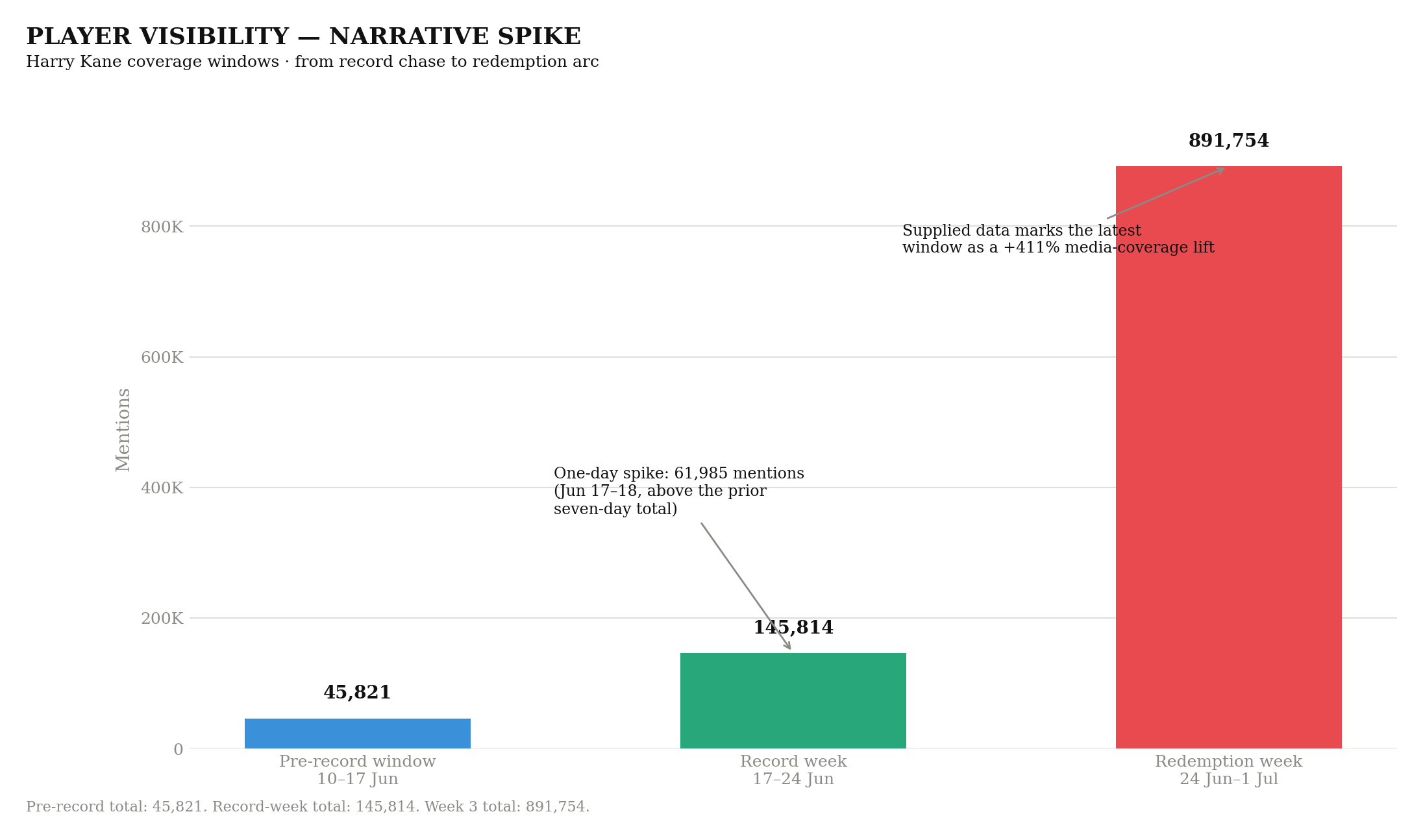
But the most dynamic player story this week is Harry Kane, who surged to 891,700 mentions and 25.9 million engagements. Kane’s coverage profile is not a single spike; it is a three-stage climb. Before the record window, Kane generated 45,821 mentions. In the following window, he rose to 145,814 mentions, and in the latest window, he reached 891,754 mentions—a +411% media-coverage increase. His story survived multiple news cycles because it kept changing form: first a record chase, then scrutiny, then rescue, then another record.

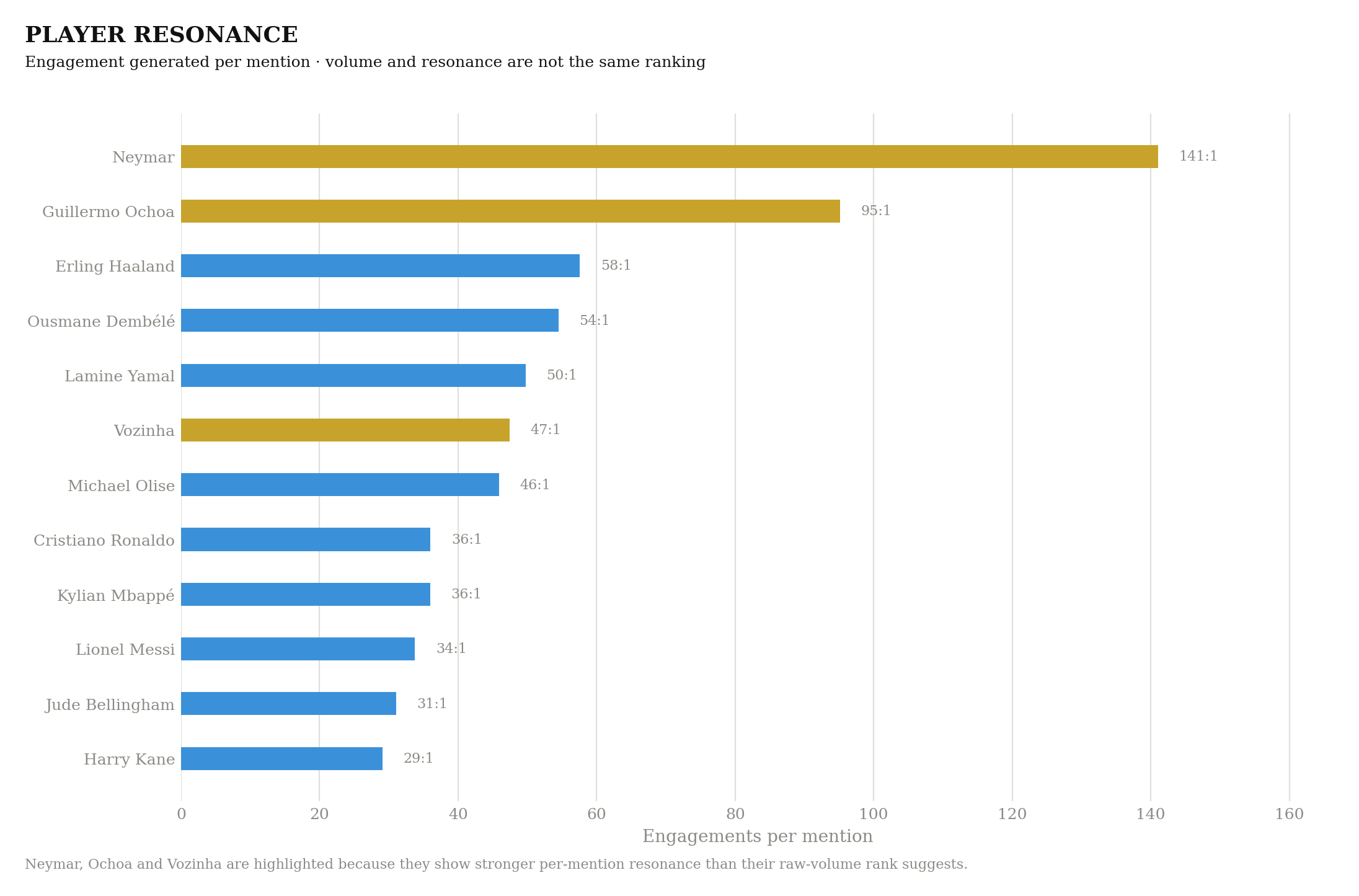
The engagement-per-mention data changes the player read. Neymar generated 104,900 mentions but 14.8 million engagements, a far higher resonance rate than most players above him on volume. Guillermo Ochoa generated 48,124 mentions and 4.58 million engagements for his emotional Azteca farewell, while Cape Verde’s Vozinha generated 37,654 mentions and 1.79 million engagements. Vozinha remains the clearest example of a fan-driven story outrunning the editorial one, generating awareness without mainstream amplification.
Kane’s coverage profile is not a single spike. It is a three-stage climb.
Before the record window, Kane generated 45,821 mentions. In the June 17–24 window, he rose to 145,814 mentions. In the June 24–July 1 window, he reached 891,754 mentions, with the supplied data marking this as a +411% media-coverage increase. On June 17–18 alone, Kane recorded 61,985 mentions in a single day, surpassing the prior seven-day total.
The important point is not just the final number. It is the persistence of the arc. Kane’s story survived multiple news cycles because it kept changing form: first a record chase, then scrutiny, then rescue, then another record. That is a stronger media asset than a one-day match spike by the numbers.

The most-covered fixture was Germany v Paraguay, with 362,845 mentions, followed by Brazil v Japan at 310,400. These produced the strongest volume, but their shape is closer to a match spike than a sustained tournament narrative.
Algeria 3-3 Austria (101,100 mentions) is the clearest example of narrative persistence outrunning the originating event. The draw eliminated Iran, who weren’t on the pitch. The match result mattered, but the surrounding political and governance narrative gave it a longer tail.
Belgium 3-2 Senegal is this week’s clearest case of a result becoming secondary to the way it happened. A stoppage-time VAR penalty review lasting over seven minutes sparked fury, but Senegal’s decision to accept the result without protest was widely covered as a deliberate contrast to their walkout at January’s Africa Cup of Nations final.
The hashtag data shows that the tournament’s social identity is not controlled by one official tag. #FIFA led by volume with 5.8 million mentions, but #FIFAWorldCup generated 417.7 million engagements from 3.6 million mentions—roughly twice the engagement of #FIFA despite fewer uses.
This is also where the fan agenda separates from the mainstream media agenda:


Football performance and results led with 47% share of voice. Player and team visibility followed with 28%. Culture, community and fan experience was third with 7%.
The off-pitch themes remain important, but they are now smaller and more concentrated. Governance, legal and reputational risk represented 1% of the coded theme sample. Travel, immigration and access also represented 1%. The overall sentiment is mostly neutral or positive, with negative sentiment at 9% overall. The tournament’s general media climate is therefore not negative; reputational negatives are clustered inside a narrower group of issue-led articles.
Issue influence—where access, immigration, governance, visa or reputational issues shaped the football narrative—stayed flat at 12% of the coded sample (584 items).
However, the sentiment inside the issue-coded pool remains highly negative. In the latest week, 42 of 67 issue-coded articles were negative. That puts negative sentiment inside issue-influence coverage at roughly 63%, far above the overall tournament negative rate of 9%.
The continuing stories include a proposed class-action lawsuit filed against StubHub over undelivered tickets, a wave of denied visitor visa applications for fans travelling to Canadian-hosted matches, and a growing fan and pundit backlash against VAR’s expanding role following contested penalty decisions and red cards.

The central media-intelligence question this week is: which stories are earning attention through football performance, and which are earning attention through narrative force beyond the pitch?
The data gives a clearer answer than a standard leaderboard. Mexico owns the broader team conversation, but its visibility is split between football achievement, host-nation energy, and fan culture. Japan is the ranking-adjusted over-performer in the team coverage model. At the player level, Messi still owns scale, Kane owns momentum, and Neymar, Ochoa, and Vozinha own resonance per mention.
The most accurate reading heading into the next round is that World Cup 2026 now has two parallel media tracks. One is a football-and-fan-culture track that is large, positive-to-neutral, and increasingly rich. The other is an access, governance, and reputation track that is smaller, but much more negative when it appears. Neither cancels out the other. They are moving side by side.
Methodology: This analysis is based on CARMA monitoring data supplied for FIFA World Cup 2026-related coverage between 23 June and 1 July 2026, covering online news, print, broadcast, and social media. Quantitative inputs include coverage volume, media-type split, team and player mention levels, hashtag activity, theme breakdowns, sentiment, issue-influence coding, and match-level volumes. The coverage surplus/deficit model uses actual team coverage share from the top-team volume dataset compared with expected share calculated from inverse FIFA ranking weights across the tracked teams.