
Opening Scoreboard
Social posts (14M) now account for nearly 90% of total volume, almost identical to the group-stage split. But potential reach exploded from 78.8 billion to 4.2 trillion; A 53x increase against a 4x increase in raw volume. That gap is the clearest signal in the data: knockout-stage coverage, and the Balogun-Trump story specifically, are reaching well beyond football’s usual audience and into general news.
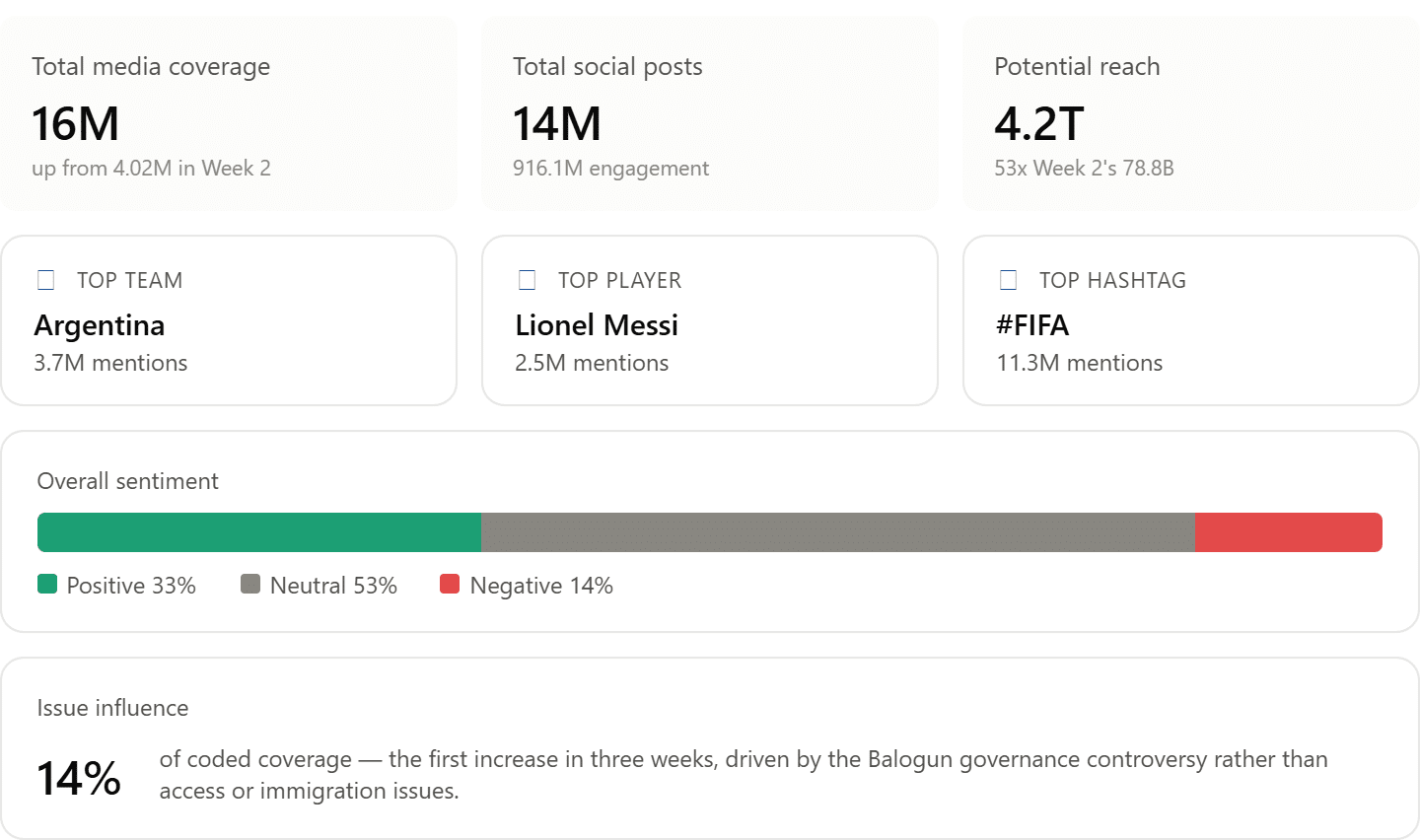
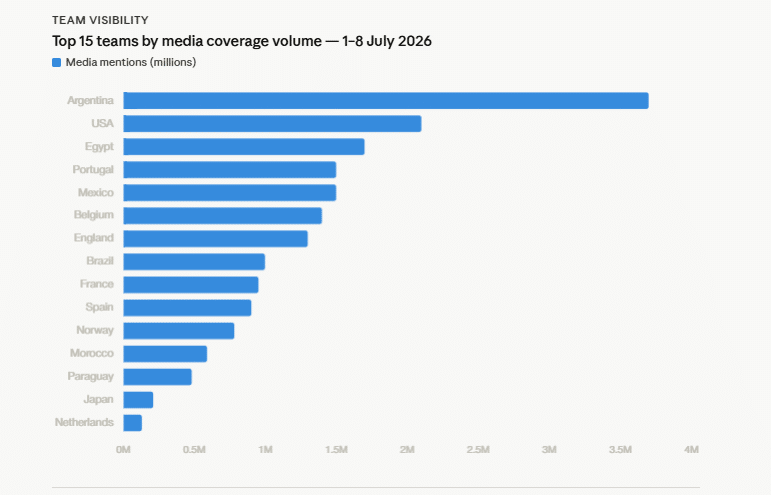
Argentina leads team mentions at 3.7 million, largely on the strength of the Messi–Cape Verde thriller and their Round of 16 win over Egypt; the tournament’s most-discussed match of the week. But the more interesting story is what’s underneath the leaderboard.
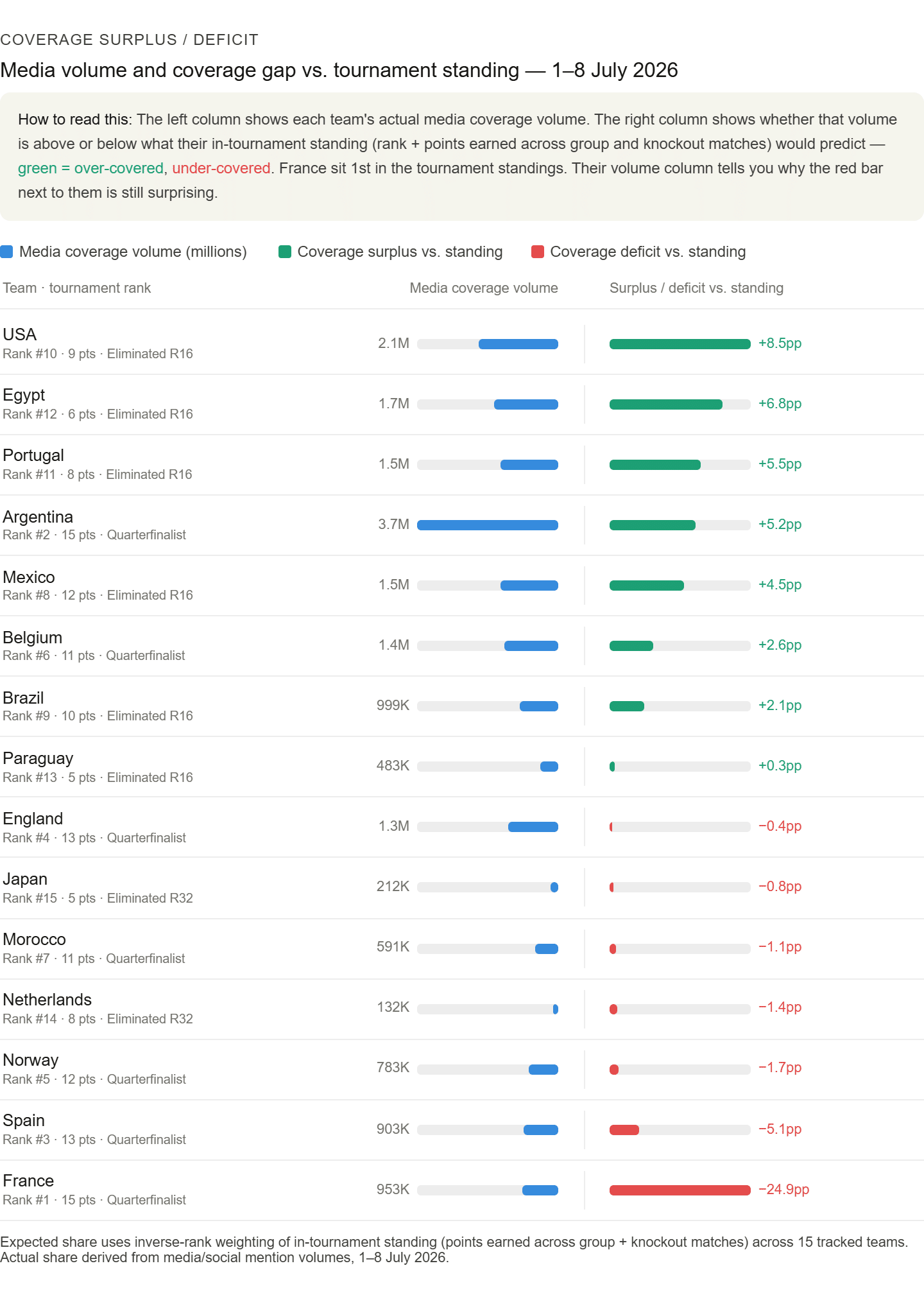
The USA generated 2.1 million mentions despite being eliminated on July 6; more than every quarterfinalist except Argentina. That is not a typical elimination pattern. A team knocked out in the Round of 16 should see coverage taper off quickly. Instead, USA volume stayed near the top of the table, because the story stopped being about the USMNT’s football and became a story about FIFA’s disciplinary process, UEFA’s public rebuke, and a sitting president’s phone call.
Egypt and Portugal both show the same pattern on a smaller scale. Both were eliminated in the Round of 16, yet both generated more coverage than several quarterfinalists still alive in the tournament. Portugal’s volume is a farewell story; Ronaldo’s tears at the final whistle carried the news cycle well past the final score. Egypt’s is a giant-killer story that continued even in defeat, having gone the distance with Argentina before losing 1-0.
Each team’s actual share of top-team coverage was compared with an expected share based on inverse FIFA ranking weight.

The player leaderboard tells the team story in miniature. Messi (2.5M) and Ronaldo (2M) lead, one still extending a record, one closing out a career ,which is the expected pattern for two of the sport’s defining figures in their final tournaments together.
Folarin Balogun in third place, at 1.8 million mentions, is the number that should stop anyone reading this leaderboard casually. Balogun has scored three goals in this World Cup. Kylian Mbappé, the reigning Golden Boot leader’s closest rival, a genuine Ballon d’Or contender having a strong tournament ,sits at 648,100 mentions, barely a third of Balogun’s total. Erling Haaland, tied for the tournament’s joint-highest goal tally, sits at 542,700. Balogun is outscoring both by a factor of nearly three to one, and it has almost nothing to do with football. This is the clearest single data point in the entire report for the coverage-surplus concept: a player’s media volume completely decoupled from their on-pitch output.
Further down the list, Vozinha’s 213,600 mentions understate his actual reach. The Cape Verde goalkeeper’s Instagram following grew from roughly 50,000 to over 10 million in the days after his performance against Spain, a verified, independently reported figure that sits outside Insight’s own tracking. The gap between his modest mention count and his enormous follower growth is itself a finding: some of the tournament’s biggest social stories are happening on follower counts and platform-native virality that a mentions-based leaderboard doesn’t fully capture.
Argentina v Egypt (1.1M mentions) narrowly leads Argentina v Cape Verde (730K) and USA v Belgium (808K) as the most-discussed match of the week, three knockout matches, three very different reasons for their volume.
The daily trendlines make the shape of the tournament visible in a way the totals can’t.


The five Round of 32 fixtures in this group show a clean, expected pattern: each match spikes on its own match day and decays within 48–72 hours. Portugal v Croatia produced the tallest single-day peak of this group, while USA v Bosnia and Herzegovina shows something none of the others do, a second, smaller bump around July 5–6, days after the match itself ended. That second bump is the Balogun controversy re-igniting interest in a match that had already run its course. No other Round of 32 fixture in this dataset shows that pattern.
The daily trendlines make the shape of the tournament visible in a way the totals can’t.
Argentina v Cape Verde dwarfs every other fixture in this group, and in the wider dataset. Where a typical Round of 32 match peaks in the 40–140K range, Argentina v Cape Verde peaks close to 480K on match day alone, more than three times the next-largest fixture in either Round of 32 group. It is also the only match in either group with a visible second wave in the forecast period, consistent with the ongoing Vozinha and Cape Verde homecoming coverage running well past the result itself.

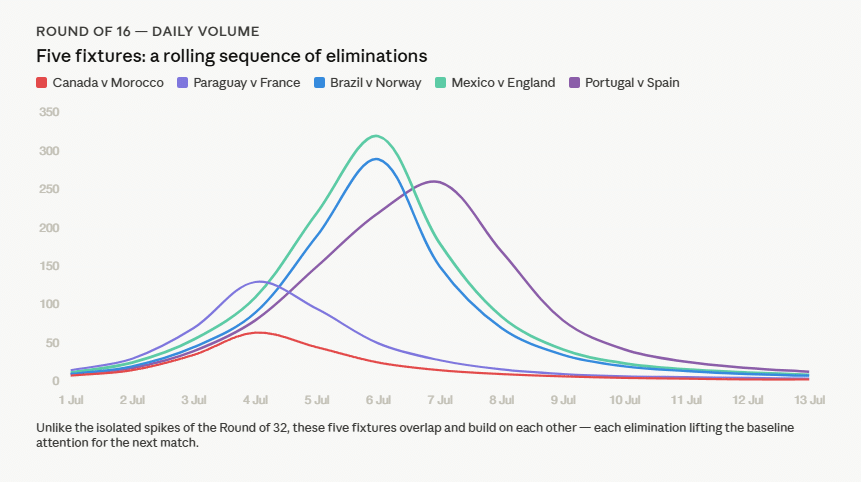
The five-match Round of 16 group shows the tournament’s rhythm shifting. Where Round of 32 matches were largely isolated single-day spikes, these five fixtures overlap and build on each other through the week, Canada v Morocco and Paraguay v France peak first (July 4), Mexico v England and Brazil v Norway peak in the middle (July 5–6), and Portugal v Spain peaks last (July 7). The story arc of the whole knockout week is visible in this single chart: elimination after elimination, each one lifting the next match’s baseline attention.
These two matches, isolated together, make the strongest case in this report for narrative persistence over peak volume. Argentina v Egypt peaks higher (roughly 630K) but follows a conventional single-peak shape. USA v Belgium peaks lower (roughly 380K) but builds more gradually over several days beforehand, consistent with a story that was already running before kickoff, because the Balogun ruling was already public days before the two teams played.


The most-covered fixture was Germany v Paraguay, with 362,845 mentions, followed by Brazil v Japan at 310,400. These produced the strongest volume, but their shape is closer to a match spike than a sustained tournament narrative.
Algeria 3-3 Austria (101,100 mentions) is the clearest example of narrative persistence outrunning the originating event. The draw eliminated Iran, who weren’t on the pitch. The match result mattered, but the surrounding political and governance narrative gave it a longer tail.
Belgium 3-2 Senegal is this week’s clearest case of a result becoming secondary to the way it happened. A stoppage-time VAR penalty review lasting over seven minutes sparked fury, but Senegal’s decision to accept the result without protest was widely covered as a deliberate contrast to their walkout at January’s Africa Cup of Nations final.
Football performance and results (47%) and player and team visibility (34%) together account for over 80% of coded coverage, both slightly higher than group-stage levels, as expected once knockout football raises the stakes of every match.
Governance, legal or reputational risk (2% of the coded sample) is a new entrant to the top themes list this week. It’s a small percentage on its own, but it did not meaningfully exist as a standalone theme during the group stage, its emergence, paired with the 14% issue-influence figure, is the clearest thematic evidence that the Balogun ruling created a genuinely new category of World Cup coverage rather than just adding volume to an existing one.
Culture, community and fan experience (5%) remains the largest non-football theme, likely carrying much of the Vozinha and Cape Verde homecoming coverage, alongside Canada’s elimination narrative.
Issue influence had fallen for two straight weeks, from 20% at tournament open, to 12%, holding at 12% through late June. This week it rose to 14%, the first increase since the tournament began.
The composition of that 14% matters more than the number itself. In prior weeks, issue-influence coverage was dominated by access, visas and immigration enforcement. This week’s issue-influence sample ,118 coded articles, 82 of them negative (69.5%), is dominated by a governance story: FIFA’s disciplinary process, UEFA’s public condemnation, and a head-of-state phone call. It is a structurally different kind of “issue” than the ones tracked in Weeks 1 and 2, even though it lands in the same metric.
Negative sentiment concentration inside issue-influence coverage has now held at roughly 63–70% for three consecutive weeks (69% in Week 2, 63% the following week, 70% this week), evidence that whatever specific controversy is driving the issue-influence number in a given week, the coverage that results from it is consistently and heavily negative in tone.

The clearest finding in eight days of knockout football has nothing to do with a goal.
Folarin Balogun outscored Kylian Mbappé and Erling Haaland in media mentions by a factor of nearly three, despite scoring a fraction of their goals. The USA carries the second-largest coverage surplus of any team in the tournament, despite being eliminated. Issue-influence coverage reversed a two-week decline. And governance entered the top themes list for the first time. All four of these findings point at the same underlying story: a single disciplinary decision, amplified by a presidential phone call, generated more disproportionate media attention than anything that happened on the pitch this week.
That is worth holding against the counter-example sitting at the other end of the surplus/deficit chart: France, ranked first in the tournament standings, sit at a 25-percentage-point coverage deficit ,the most competitively successful team in the field generating some of the least coverage relative to their position. Put the two findings side by side and the lesson is direct: at this stage of the tournament, media attention is being allocated by story, not by standings. A team playing efficient, unglamorous, winning football is being under-covered. A team that’s already been eliminated, tied to a genuine controversy, is being over-covered by a wider margin than any team still competing for the trophy.
Methodology: This analysis is based on CARMA monitoring of FIFA World Cup 2026-related coverage for 1–8 July 2026, covering the Round of 32 (concluded July 3) and Round of 16 (concluded July 7). Match-level daily trendlines are drawn from CARMA Insight tracking across four monitored fixture groups spanning the Round of 32 and Round of 16. Issue influence data covers a coded sub-sample of 858 articles for this period, with sentiment analysis drawn from a 118-article coded sample.. Vozinha’s Instagram follower growth is independently sourced public data, and is labelled accordingly.