

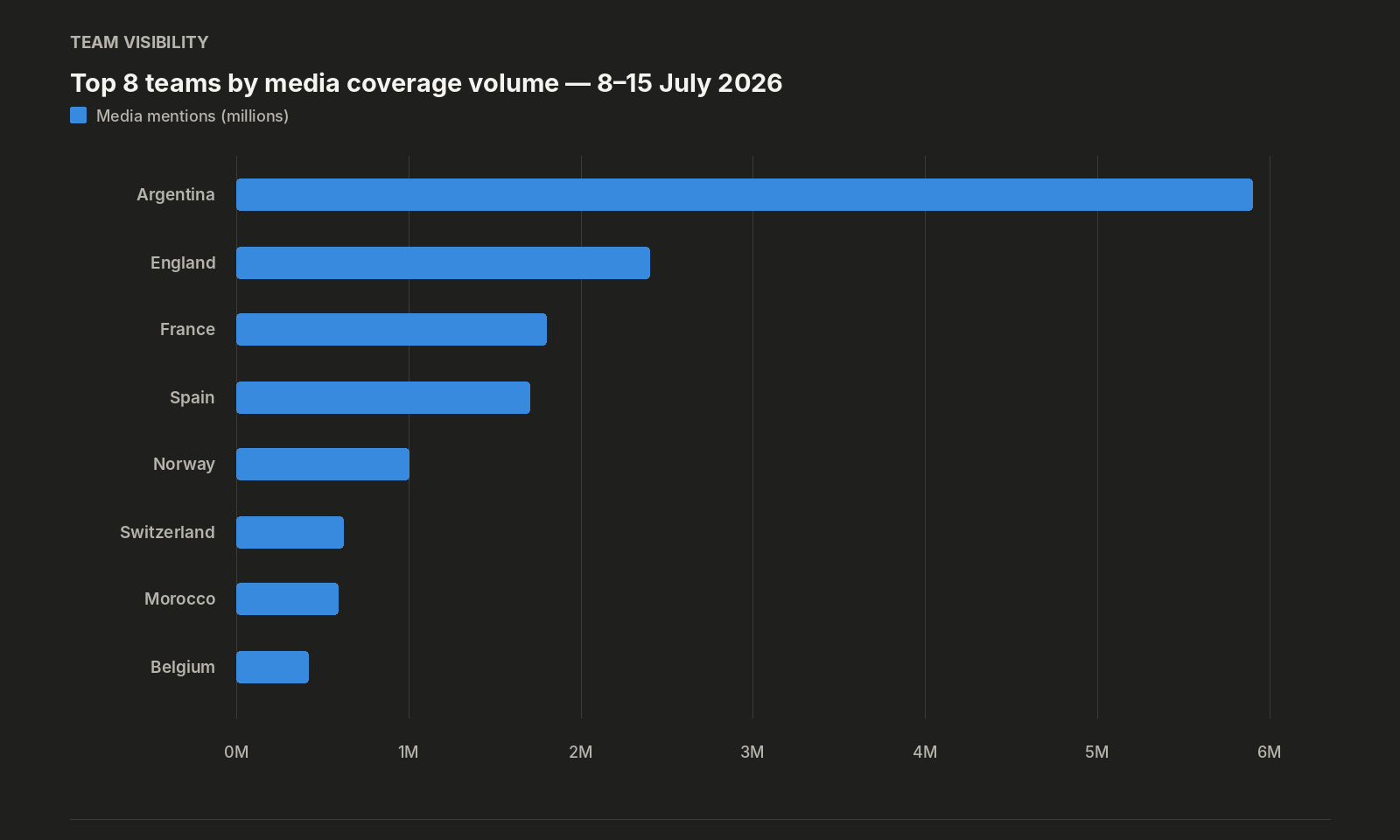
Argentina leads team mentions at 5.9 million; expected, given they’re one win from defending their title. But the coverage surplus model tells a sharper story underneath that.
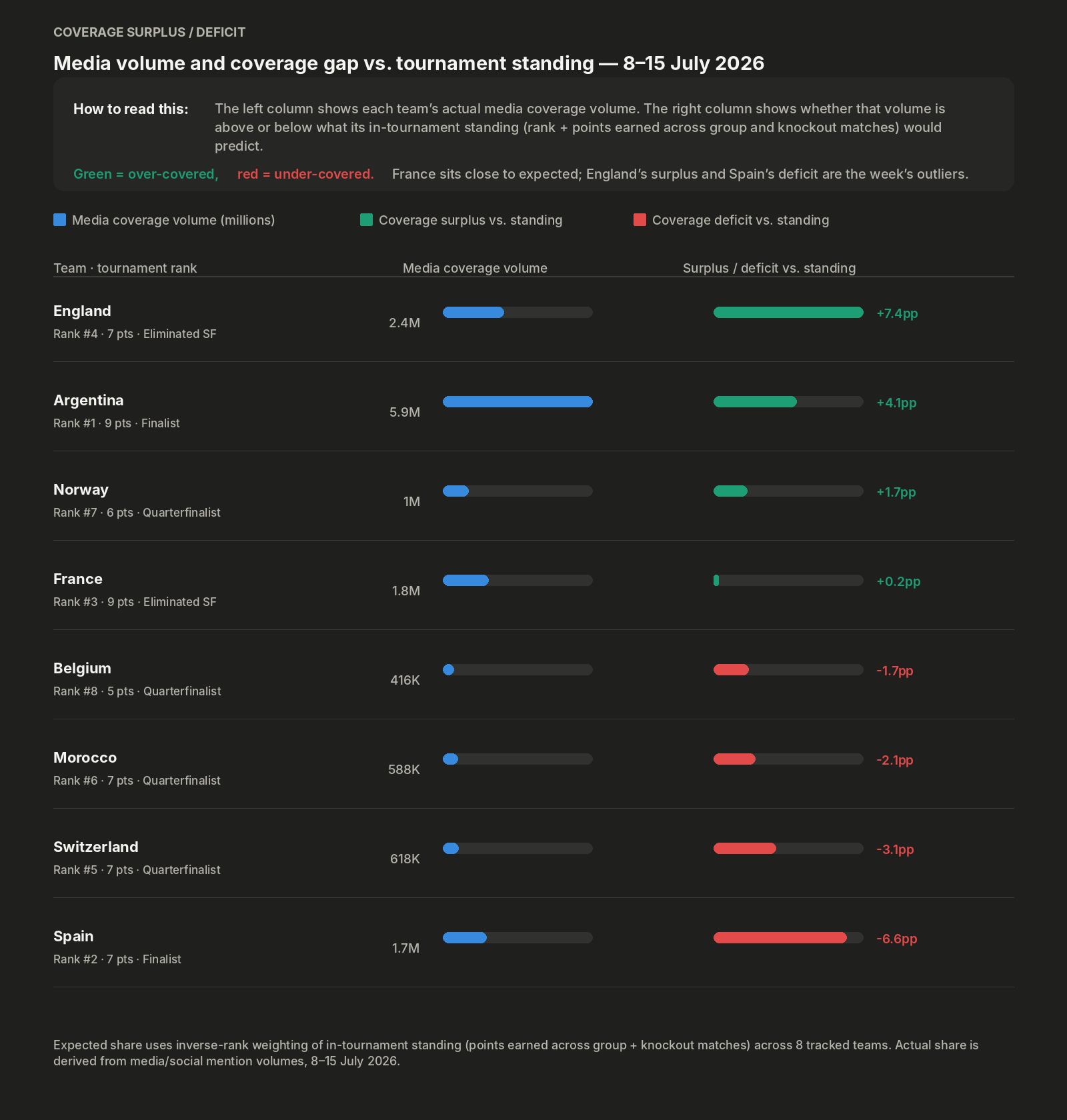
Spain’s -6.6pp deficit is this week’s standout finding, and it’s a direct echo of France’s -24.9pp deficit from the previous report. Spain reached their first final in sixteen years with comfortable, controlled football; a clean 2-1 quarterfinal win over Belgium, a clean 2-0 semifinal win over France. No extra time, no late drama, no controversy. Ranked #2 by tournament standing, Spain’s media share sits well below what that position predicts. For two consecutive weeks now, the team with the most efficient, lowest-drama route through the bracket has carried the largest coverage deficit of the field.
England’s +7.4pp surplus is the largest of any team this week; and they lost. Eliminated in the semifinal, England’s coverage share still runs well ahead of their tournament position, driven by the rivalry framing (the 1982 Falklands conflict and Maradona’s 1986 “Hand of God” were both invoked repeatedly in pre-match coverage), the dramatic finish, and English media’s generational framing of a sixth-decade wait for a trophy. This is the same shape as the USA’s +8.5pp surplus after their elimination two weeks ago: losing, dramatically and with a strong enough narrative hook, generates more coverage than winning quietly.
Argentina’s own surplus (+4.1pp) is comparatively modest this week; smaller than in any previous report; because for the first time all tournament, their coverage volume is largely proportionate to where they’ve actually finished: one win from the trophy.
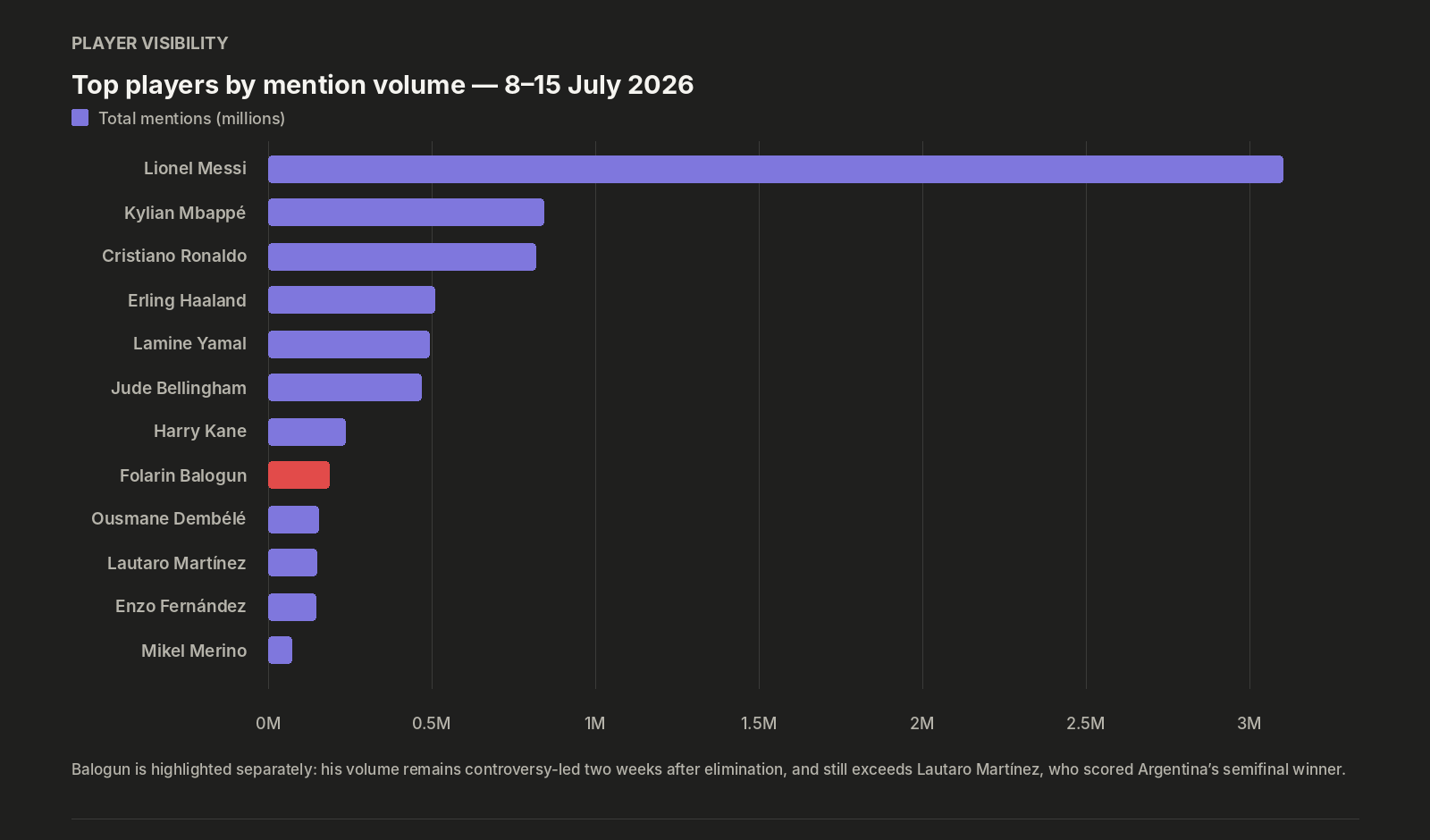
Messi leads at 3.1 million mentions, more than triple Mbappé (841,100) in second place. The gap between them is now almost entirely explained by tournament stage: Messi is playing Sunday, Mbappé’s tournament ended Tuesday.
The most striking finding on this leaderboard is Cristiano Ronaldo, in third place with 817,352 mentions; ahead of Erling Haaland (507,500), who played an actual quarterfinal this week. Ronaldo was eliminated in the Round of 16 more than a week before this reporting period even began. His farewell narrative is generating more media volume than a player who is still competing. This is the clearest evidence yet in this project that legacy coverage operates on its own timeline, independent of whether a player is still in the tournament.
Folarin Balogun’s 186,254 mentions tell the same story at smaller scale. He’s been eliminated for two weeks, yet still out-mentions Lautaro Martínez (146,200), who scored Argentina’s stoppage-time winner against England four days ago. The Balogun-Trump controversy has now demonstrated staying power across three consecutive reporting periods.
Lamine Yamal (491,500 mentions, Spain’s breakout teenager) and Jude Bellingham (468,100, England’s best individual performer this tournament) round out the group of players whose coverage is tied directly to this week’s football rather than legacy or controversy.
| Match | Volume | Engagement |
|---|---|---|
| England v Argentina | 1.2M | 28.4M |
| France v Spain | 767.8K | 28.2M |
| Norway v England | 640.9K | 27.4M |
| Argentina v Switzerland | 467.2K | 17.1M |
| France v Morocco | 426.9K | 14.9M |
| Spain v Belgium | 266.3K | 12.5M |
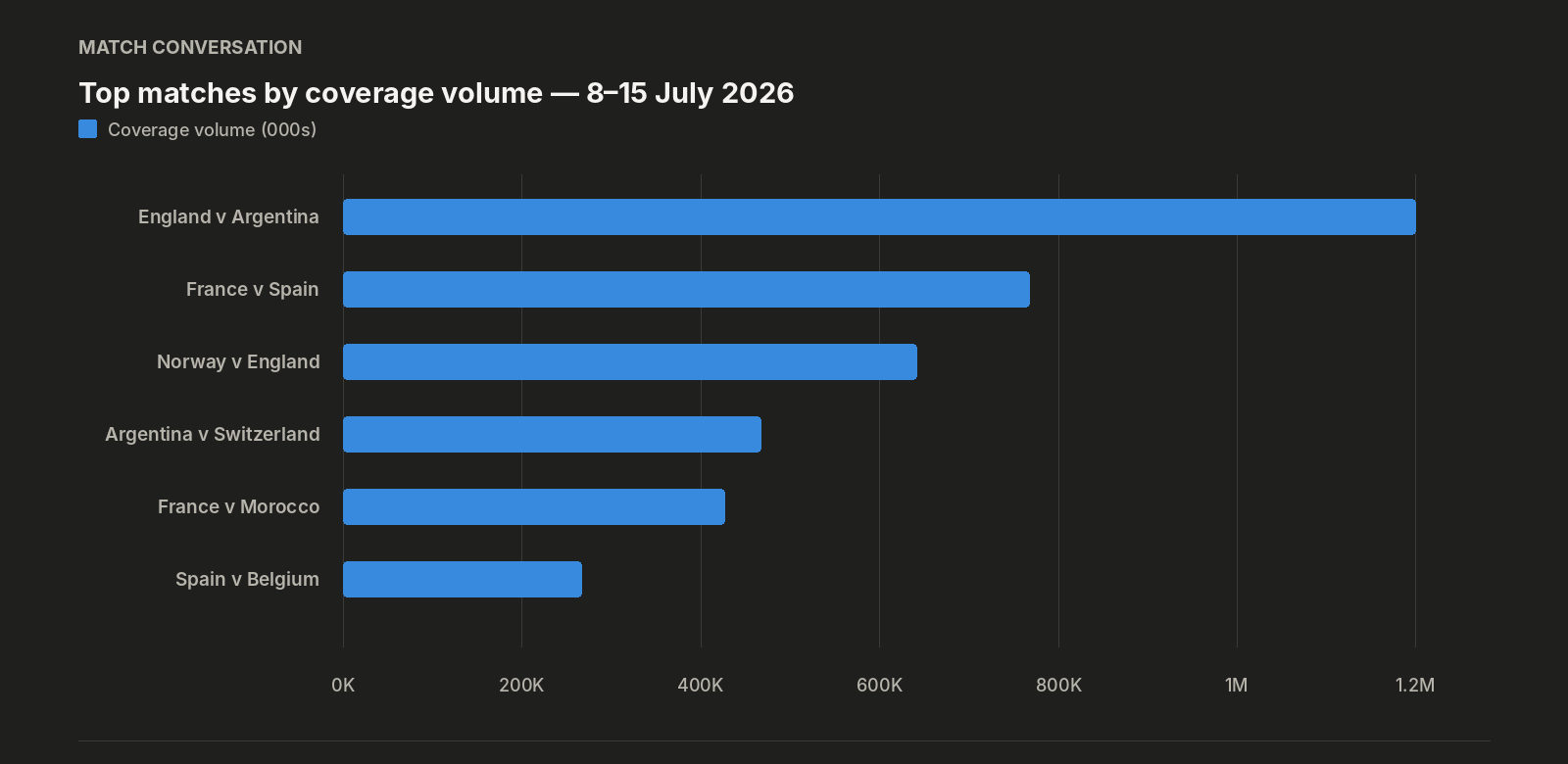
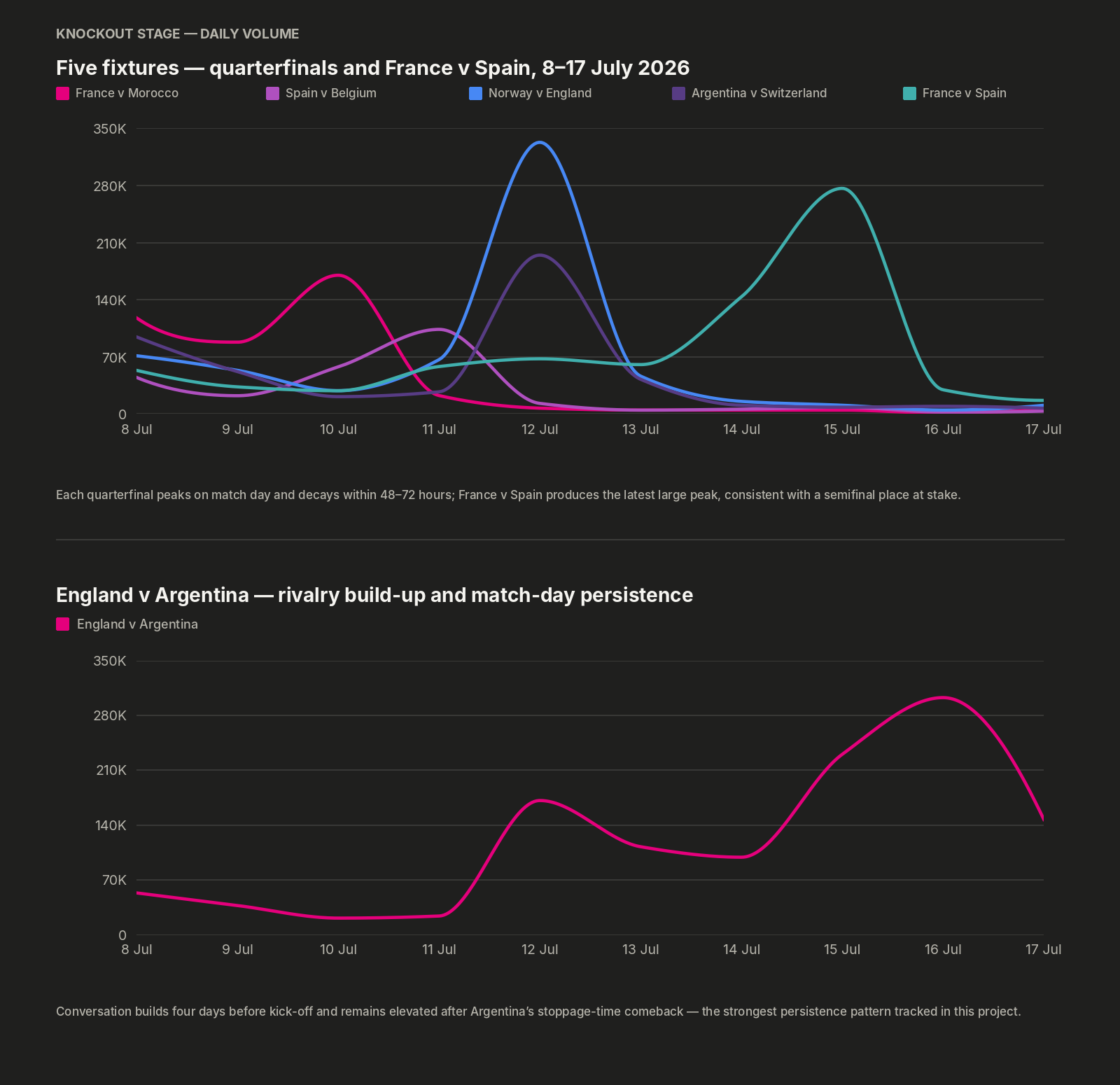
The four quarterfinals show a clean, predictable pattern: each peaks on its own match day and decays within 48–72 hours, with peak height tracking closely to eventual total volume ; Norway v England peaked highest among the quarterfinals (consistent with its 640.9K total), Spain v Belgium lowest (266.3K). France v Spain, played three days later as a semifinal, produced both the latest and largest peak of the five fixtures shown, as expected for a match with a final place at stake.
England v Argentina, isolated on its own, is the strongest persistence story this project has tracked. Volume was already building four days before kickoff; well above baseline by July 10–11, driven by the rivalry angle rather than match-specific news. It then produced sustained high volume through match day and into the days after, with the forecast period showing renewed elevation around July 18–19, when England play the third-place match and Argentina play the final. Net sentiment on this match swung dramatically negative in the pre-match build-up (17% positive vs. 25.3% negative overall for the tracked period) before an extraordinarily volatile match day, with sentiment swinging between sharply positive and sharply negative within hours; consistent with a match that went from England’s 55th-minute lead to Argentina’s two-goal turnaround in the final ten minutes.
#FIFA leads at 8.8 million mentions, with #Football (6.8M) and #Argentina (5.8M) close behind. #FIFAWorldCup, at only 2.2 million mentions, has by far the highest engagement-to-volume ratio of any major tag (323.5M engagement); a smaller, more concentrated audience engaging unusually heavily with official content.
Two queries this week returned genuinely informative zeroes. A direct search for the literal hashtag #WorldCupFinal (4.4K) returned minimal coverage; not because no one is discussing Sunday’s final, but because the conversation is happening under #FIFAWorldCup, #FIFA, #Argentina and #Spain rather than a dedicated final-specific tag. Likewise, a search for hashtag #MbappeRacism returned no results. However, this does not mean people are not discussing the racism story. When the search was widened to include Mbappé’s name, racism-related words, and World Cup terms, it found 659 mentions and 1,400 engagements. This shows the story is being discussed, but not through one main hashtag. Separately, the broader #Mbappé hashtag had 15,900 mentions. The lesson for future weeks: a governance story doesn’t need its own hashtag to generate real coverage; measuring it requires a contextual query, not a literal tag search.

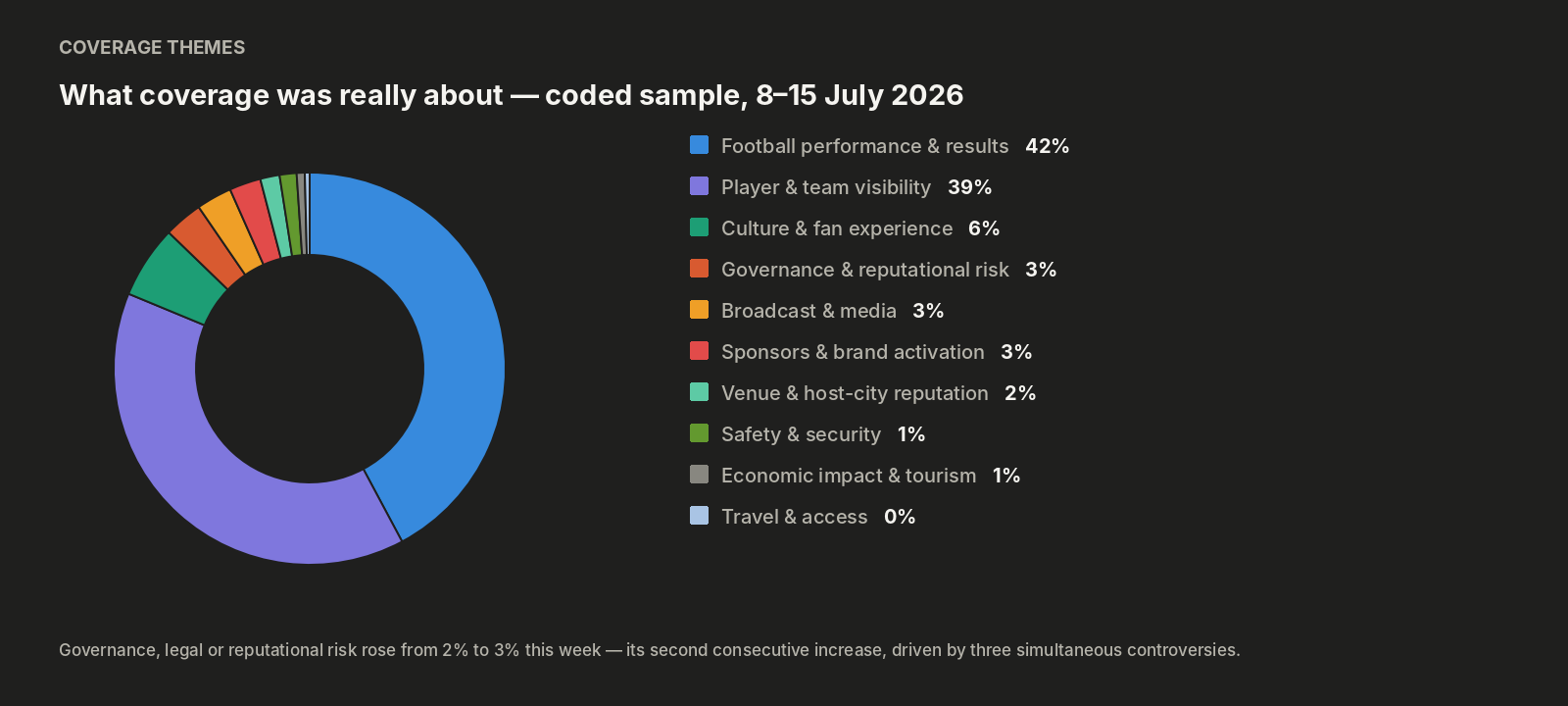
Governance, legal or reputational risk rose from 2% to 3% of the coded sample; confirming the prediction from the previous report that three simultaneous controversies (the Mbappé racism scandal, continued Balogun fallout, and Egypt’s officiating complaint) would push this theme higher. It’s a modest-looking rise in isolation, but it’s now risen in back-to-back weeks, and the issue-influence figure below shows the real scale of what’s behind it.
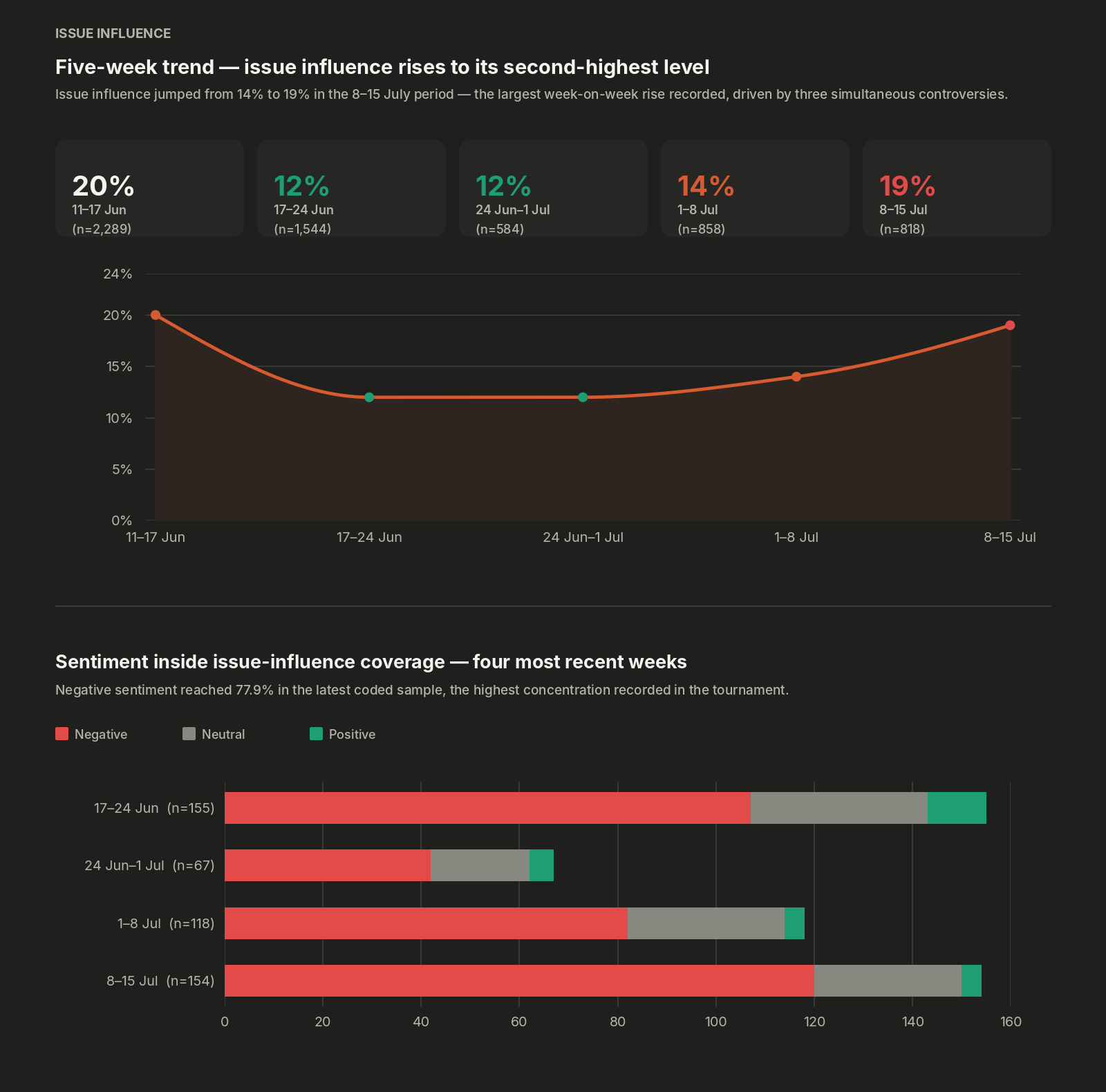
Issue influence jumped from 14% to 19% this week; the largest single-week increase recorded in this project, and the second-highest reading of the tournament, trailing only the opening week’s 20%.
The sentiment inside this week’s issue-influence coverage is the most negative yet recorded: 120 of 154 coded articles (77.9%) carried negative sentiment; well above the 63–70% range held across the previous three weeks, and consistent with the prediction in the prior report that the Mbappé racism scandal specifically would push negative concentration higher than anything seen so far. With three distinct controversies live simultaneously; a UN-level human rights statement, a disciplinary and political-interference story, and a formal officiating complaint; this week’s issue-influence figure is not one story wearing the metric; it’s three.
The team with the least dramatic route to the next round keeps carrying the largest coverage deficit. France’s -24.9pp deficit last week and Spain’s -6.6pp deficit this week are the same finding in two different teams: competitive success without controversy or drama does not convert into proportionate media attention. Meanwhile the team with the most dramatic exit; the USA two weeks ago, England this week; keeps carrying the largest surplus. Winning quietly is being under-covered. Losing loudly is being over-covered. That’s now a pattern, not a coincidence.
Legacy has its own gravity, independent of the tournament calendar. Ronaldo, eliminated more than a week before this reporting period began, out-mentioned an active quarterfinalist. Balogun, eliminated two weeks ago, out-mentioned the man who scored this week’s decisive goal. Neither needed to still be playing to still be driving coverage.
And the issue-influence jump to 19% is the clearest evidence yet that this tournament’s governance stories are compounding rather than resolving. Three separate controversies; one of which required a UN Human Rights Office statement; pushed negative sentiment inside issue-influence coverage to its highest level of the tournament. With the final still to come, that number is worth watching closely: whether it falls back toward baseline once the trophy is decided, or whether governance coverage has now become a permanent fixture of how this World Cup is remembered.
Methodology: This analysis is based on CARMA monitoring of FIFA World Cup 2026-related coverage for 8–15 July 2026, covering the Quarterfinals (concluded July 11) and Semifinals (concluded July 15). The coverage surplus/deficit model uses each team’s actual media share compared against an expected share calculated from inverse-rank weighting of in-tournament standing across the 8 tracked teams; ambiguous ranks in the source data were resolved using tournament stage reached, then points earned, as described above. Match-level daily trendlines are drawn from CARMA Insight tracking across the four quarterfinals and the England v Argentina semifinal. Issue influence data covers a coded sub-sample of 818 articles for this period, with sentiment analysis drawn from a 154-article coded sample. Hashtag figures marked as zero reflect literal tag-string searches; contextual boolean queries returned real, if modest, volume for the same underlying stories, as noted above. No statistics, quotes or media examples have been fabricated.