
Opening Scoreboard, June 17 – June 24, 2026
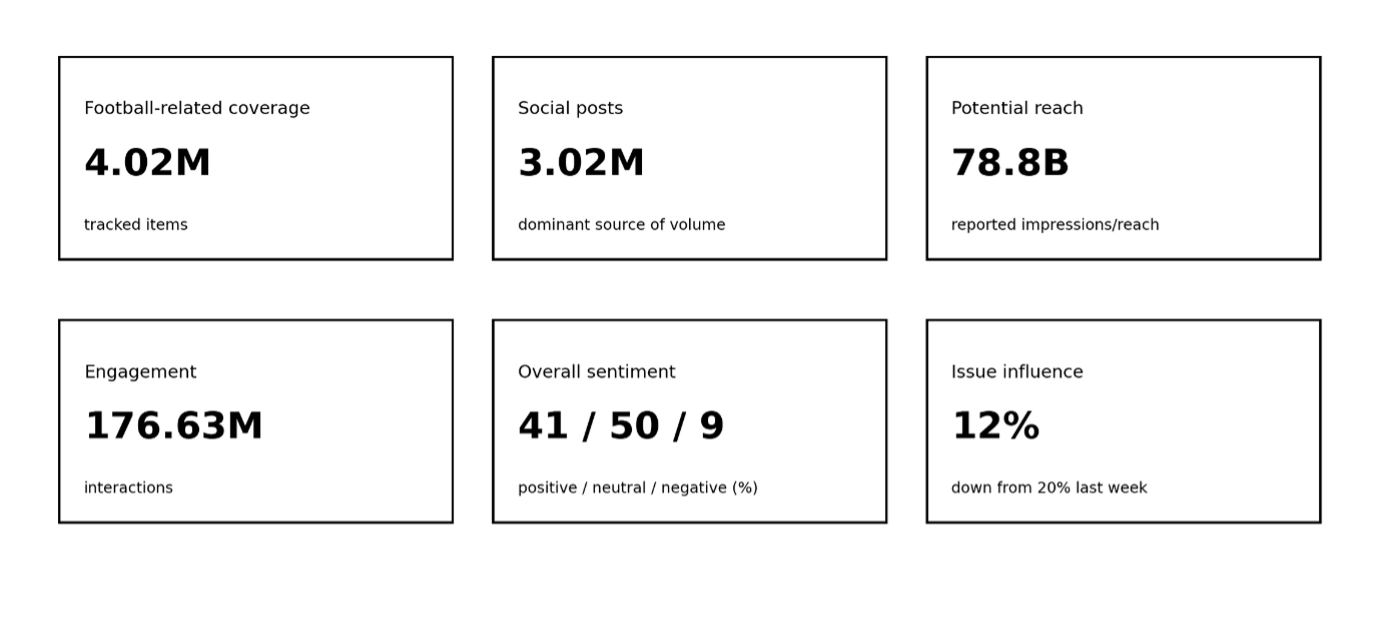
The week generated 4.02 million football-related items, including 3.02 million social posts, 176.63 million engagements and 78.8 billion reported potential reach/impressions. The overall tone was steady: 41% positive, 50% neutral and 9% negative.
The dominant theme was football performance and results, at 45% of the sample. That is the key shift from the pre-tournament period. Match results now lead the story, even though off-pitch issues still influence 12% of sample coverage.
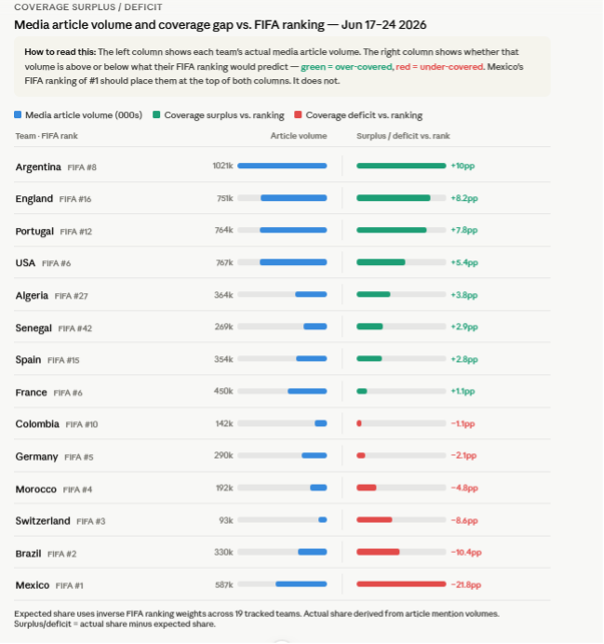
Argentina leads media articles at 1.02 million items. Analysis shows this was driven less by Argentina as a country and more by a Messi-led media narrative. Argentina’s FIFA ranking of 8 would predict roughly 3.7% of coverage based on their footballing weight. They received 13.7%. That 10-percentage-point surplus represents approximately 745,000 additional article mentions beyond what their ranking would generate. Remove Messi’s record-breaking week and the surplus likely collapses.
Mexico leads combined-platform coverage at 1.4 million mentions but trails Argentina significantly in media coverage. In the editorial layer that drives 594 billion in potential reach, Mexico is the fifth-most-covered team. Their social lead is clear: fan culture and Merlin the duck, Mexico’s mascot, were the main drivers of this visibility, rather than the sustained editorial coverage usually required to hold a top-five media ranking.
Morocco is the most undervalued story in the data. Ranked fourth globally and having beaten Scotland, Morocco received only 2% of total coverage share. Their coverage deficit of −4.8 percentage points is significant for a team of their calibre and a genuine finding: the media conversation is persistently under-indexing one of the tournament’s most competitive sides.
Three findings stand out:
Algeria’s +3.8pp surplus reveals how Messi-adjacency inflates team visibility. Algeria is ranked 27th. They received nearly five times their predicted share of coverage, not because of their own performance, but because they played Argentina. This is narrative spillover: a team’s coverage being driven by who they faced rather than what they did.
Mexico’s −21.8pp deficit is the week’s most counterintuitive finding. Mexico is ranked first by FIFA ranking, which would predict nearly 30% of all media coverage. They received 7.9%. The explanation: Mexico dominates social conversation through fan culture and Merlin, but that does not translate into the sustained editorial article coverage that drives reach at scale.
Brazil’s −10.4pp deficit, despite a 3-0 win over Scotland, shows that tournament performance and media coverage are not the same measure. Brazil won comfortably and still sits 10 percentage points below their predicted share.
No week better illustrates the gap between legacy visibility and performance visibility.
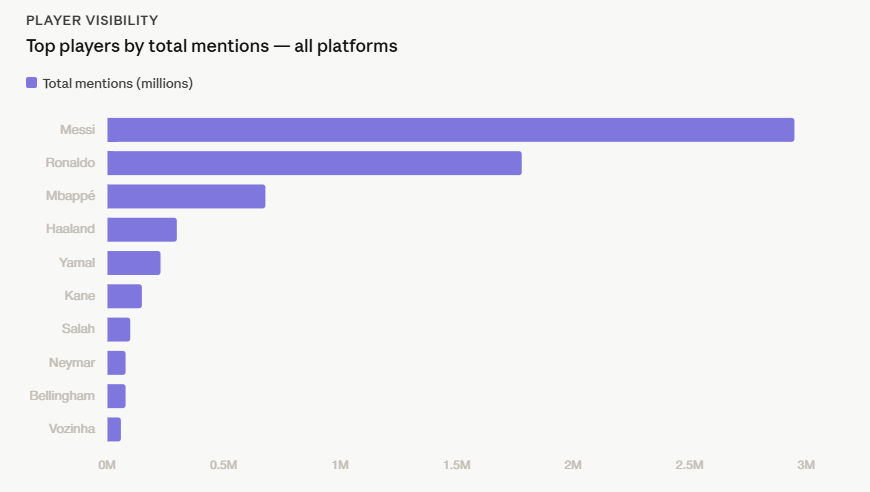
Messi (2.95 million mentions) and Ronaldo (1.78 million) together account for more than 60% of all player-level mentions tracked in the period. The remaining eight players in the top ten share the rest. Both players broke major World Cup records within 36 hours of each other. The week produced a direct legacy-versus-legacy editorial competition, and the data confirms both cleared 1 million mentions during the window.
Alex Freeman’s +171% breakout is the week’s clearest outlier story. Freeman had 5,100 mentions before his goal against Australia. In the six days after, that figure reached 13,800. The ESPN family background piece, FIFA’s own framing of a “full-circle moment,” and significant NFL audience crossover extended his coverage well beyond football-only audiences.
Vozinha of Cape Verde presents the sharpest social disconnect in the dataset. With 59,712 total mentions and only 59,700 social engagements, a near 1:1 ratio. Cape Verde’s goalkeeper is generating awareness without amplification. Compare that to Messi’s engagement-to-mention ratio of approximately 35:1. Vozinha’s story is one of the tournament’s best, but it remains niche by the numbers.
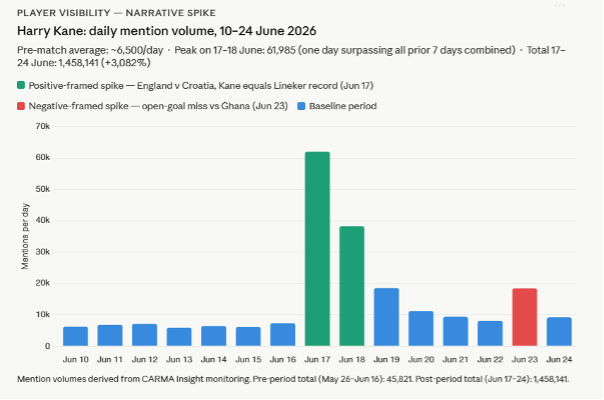
Kane entered the week with 45,821 mentions accumulated over the prior seven days. Between June 17 and 24, that figure hit 1,458,141, a 3,082% increase.
On June 17–18 alone, 61,985 mentions were recorded in a single day, surpassing all seven prior days combined.
That peak reflected his two goals against Croatia, equalling Gary Lineker’s England World Cup record of 10 goals. Six days later, his close-range miss against Ghana produced a second peak in a completely different direction.
The same player celebrated as a record-equaller became the most scrutinised performer of the round within a week. Kane’s coverage split sharply: one large positive spike and one large negative-framed spike, both within seven days.
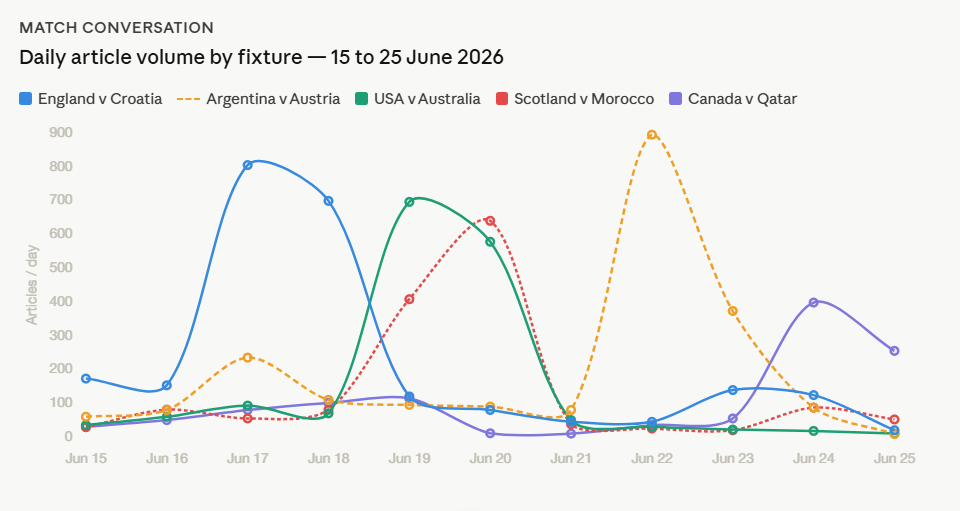
The most valuable match metric is not the peak. It is whether the story survives into the next cycle. England v Croatia had persistence. Scotland v Morocco had controversy. Argentina v Austria had a record spike.
Argentina v Austria produced the biggest single-day burst, with 895 articles on 22 June. The spike was almost entirely Messi-led. The story held the next day at 373 articles, then dropped to 87 by 24 June. This was a record moment with a clear decay curve.
England v Croatia produced the strongest sustained arc. It peaked at 805 articles on matchday and held at 699 the next day. It also resurfaced on 23-24 June in wider tournament pieces. This is the kind of match that becomes a reference point, not just a result.
Scotland v Morocco was the controversy case. Matchday coverage reached 408 articles, but post-match coverage rose to 640. That inversion shows the referee controversy was the story, not only the scoreline.
Canada v Qatar had the strangest pattern. The match produced only 114 articles on matchday, then surged to 398 articles on 24 June. The delayed lift came as Canada’s qualification story and Koné recovery coverage converged.
USA v Australia was a two-day incident spike. Coverage reached 696 articles on matchday and 578 the next day, then fell sharply. Pulisic’s injury and Freeman’s goal carried the story, but not for long.
Three viral moments illustrate where fan platforms diverge from journalist platforms:
Merlin the duck escalated into a mainstream international story this week. Merlin’s owner, street vendor Karla Gómez, was invited to President Sheinbaum’s press conference at the National Palace on 22 June. Sheinbaum named Merlin an unofficial ambassador of Mexico City. NBC News, Reuters, the Washington Post and Today.com all ran standalone features. FIFA and the Mexico team posted about him on Instagram. Content under #PatoMerlin and the phrase “Viva El Pato” generated estimated engagement of 85,000+ tagged posts, with the story spreading into communities with no football interest. This is driving Mexico’s 1.4 million platform total while generating zero tactical analysis and zero broadcast football coverage.
The Tartan Army in Miami produced the week’s most sustained fan-culture narrative. An estimated 8,000 Scotland supporters marched through Little Havana on 22 June, singing in the streets outside LoanDepot Park while Scotland players watched Argentina’s match together. ESPN, WLRN, the Miami Herald, ABC News and UK outlets all covered the fan story. Craig Ferguson, who walked 3,500 miles from Los Angeles to Boston for SAMH, completed his journey that same week. The fan experience outlived Scotland’s 3–0 defeat to Brazil on 24 June. An estimated 50,000 Scotland supporters made the trip, helping the story become a more durable media narrative than the football result.
The Iran Lion and Sun flag controversy continued to generate social reach. According to Visibrain data, TikTok videos discussing the ban accumulated more than 36 million views, the largest social-reach figure attached to any non-football story in the tournament. When content is identity-linked and politically contested, social platforms amplify it at a scale that the 12% issue-influence SOV figure does not fully capture.
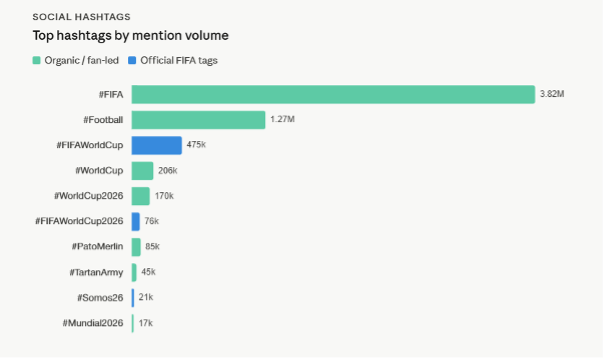
The most important hashtag finding is the gap between #FIFA (3.8 million) and #FIFAWorldCup (475,000). The tournament’s official digital identity is being used at roughly one-eighth the volume of the generic #FIFA tag. Most fan conversation is not inside the official hashtag infrastructure. It lives under shorter, algorithmically efficient tags that fan content, reaction videos and memes default to. The organic fan conversation and the official campaign conversation are two different data streams.
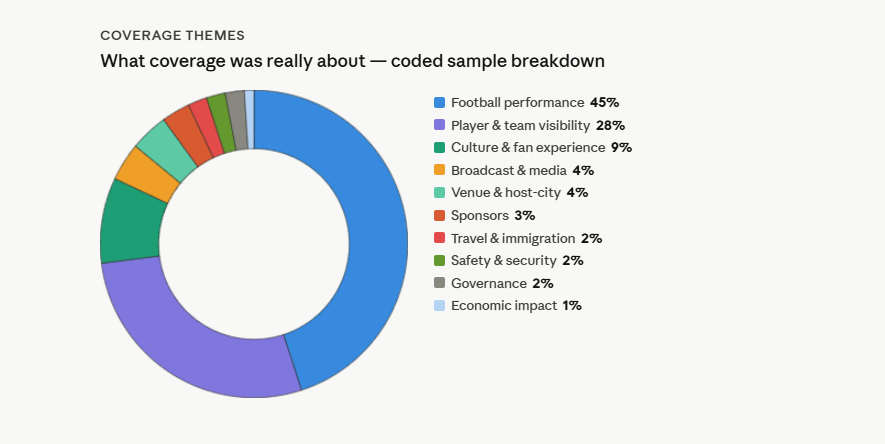
Football performance at 45% and player/team visibility at 28% together account for nearly three-quarters of coded coverage, which is the expected pattern once matches are underway.
The 9% for culture, community and fan experience is the most analytically interesting non-football theme, driven almost entirely by the Tartan Army and Merlin narratives. These are soft-power stories about how the tournament is being received, not issue stories. Their share of the coded sample likely underestimates their social footprint, because fan-culture TikTok and Instagram content produces far fewer text-based articles than it does views.
The combined access/governance/immigration cluster totals approximately 6% of the coded sample, lower than the 12% issue-influence figure, which captures a broader definition including pieces where these themes inflect but do not dominate football coverage.
Issue influence has declined from 20% to 12% week on week. This is expected: as match results accumulate, they displace issue coverage editorially.
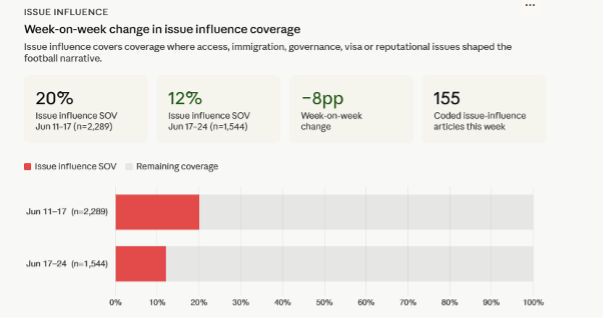
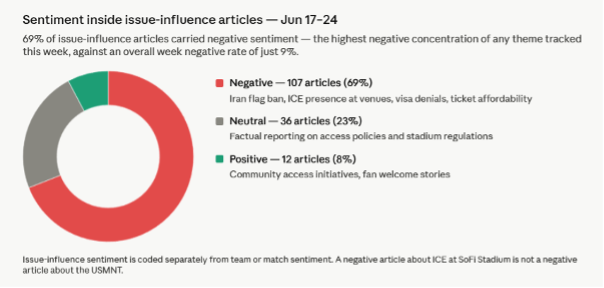
What matters more is the sentiment composition. Of 155 issue-influence articles coded this period, 107 are negative, a 69% negative concentration rate, sharply higher than the 9% overall week negative sentiment. Coverage that persists through a match-heavy news environment is more likely to represent genuine reputational concern than speculative pre-event reporting.
The continuing stories: the Iran squad situation (staff denied visas, flag ban controversy); immigration enforcement coverage near venues; and ticket affordability. The Iran flag controversy has persistence because it sits at the intersection of stadium policy, diaspora identity and free expression, a combination that generates repeated editorial angles without requiring a new factual development.
The central question every media-intelligence brief should answer is: is a team earning coverage because of what it did on the pitch, or despite what it did on the pitch?
This week’s data gives clear answers for three teams.
Argentina leads media articles at 1.02 million and carries the week’s largest coverage surplus at +10 percentage points, not because they are the highest-ranked team or the strongest match-by-match favourite, but because Messi is breaking records in front of a global media infrastructure built to amplify exactly that kind of moment. Argentina’s media dominance is a player story wearing a team jersey.
England’s +8.2pp surplus is more durable because it is more broadly distributed, player stories, tactical discussion and international reaction are all contributing, not just a single milestone. A flat performance against Ghana still generated significant coverage volume because the England narrative was already established.
Mexico’s −21.8pp deficit is the most useful single finding for understanding how the week’s media and social landscapes diverge. Mexico has the most total mentions, the most culturally resonant viral moment and a perfect group record. In the editorial layer that drives 594 billion in potential reach, they are the fifth-most-covered team. Host-nation status generates audience attention without guaranteeing editorial depth.
The three analytical lenses this blog is built around all produced findings this week. Coverage surplus identified where narrative is doing more work than ranking. Media-versus-social divergence showed that the social leader (Mexico) and the media-articles leader (Argentina) are not the same team and are not being driven by the same content. Narrative persistence distinguished the matches with real editorial staying power, England v Croatia, Scotland v Morocco, from the incident-driven spikes that lit up briefly and decayed within 48 hours.
Methodology:This analysis is based on CARMA monitoring of FIFA World Cup 2026-related coverage for 17–24 June 2026 across online news, print, broadcast, radio/podcasts and social media. Quantitative metrics are drawn from CARMA Insight monitoring data provided for this period. The coverage surplus/deficit model uses actual team SOV from article mention volumes compared against expected SOV calculated from inverse FIFA ranking weights across 19 tracked teams. Issue influence data is based on a coded sub-sample of 1,544 articles. Match-level trendlines are drawn from CARMA Insight article-level tracking across five primary monitored fixtures.
Date range: 17–24 June 2026 | Stage: Group Stage Matchdays 2–3 | Markets: Global, US, UK and Canada.
Daily trend-line charts cover 15–25 June, a broader period than the report’s main analysis timeframe. This wider view shows the peaks, troughs, spikes, and continuity of media coverage around each match analysed.